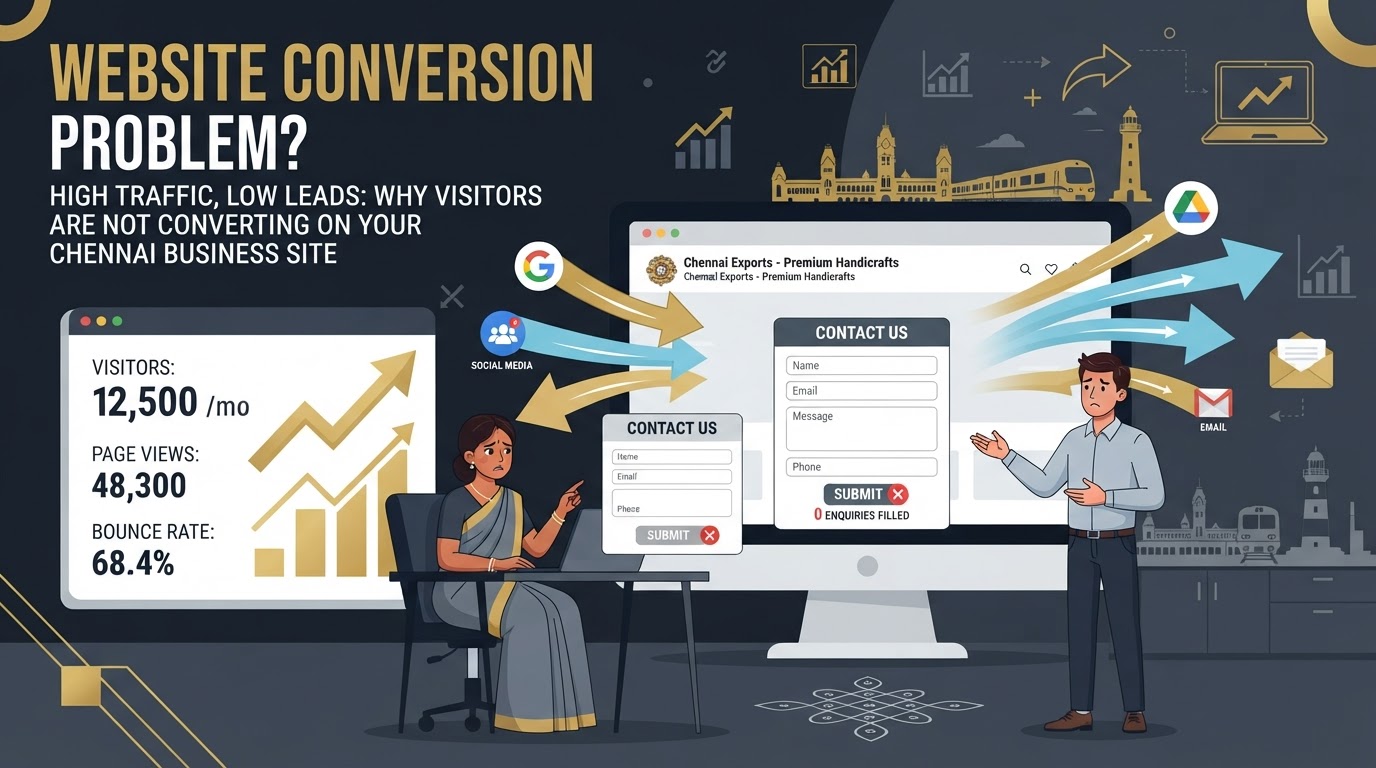
How Do I Turn More Website Visitors into Paying Customers?
The complete, end-to-end conversion system for Tamil Nadu small businesses — because traffic was never the finish line.
Revenue Mastery Consulting
Conversion Strategy Experts
Why Traffic Alone Was Never the Goal
When most small business owners talk about digital marketing, they talk about traffic.
"How do I get more visitors to my website?"
"How do I rank higher on Google?"
"How do I get more clicks on my ads?"
Traffic is the metric that's easiest to see, easiest to report, and easiest to optimise for. But traffic was never the actual goal. Revenue is the goal. Paying customers are the goal. And between a visitor landing on your website and that visitor becoming a paying customer, there are several critical stages — each with its own leakage points — that most businesses have never mapped, let alone systematically optimised.
Think of it this way: if you walked into a well-stocked shop in T Nagar, picked up a product, looked at the price tag, and then tried to pay — but the salesperson was nowhere to be found, the payment counter was hidden in the back corner, there were no price lists visible, and nobody followed up when you put the product back down and walked out — you would not buy. Not because the product was wrong. Because the system for completing the sale was broken.
This is what most small business websites in Tamil Nadu look like from the visitor's perspective. The product is often good. The traffic sometimes gets there. But the system between "visitor" and "customer" is either missing entirely or is full of gaps that leak potential revenue at every step.
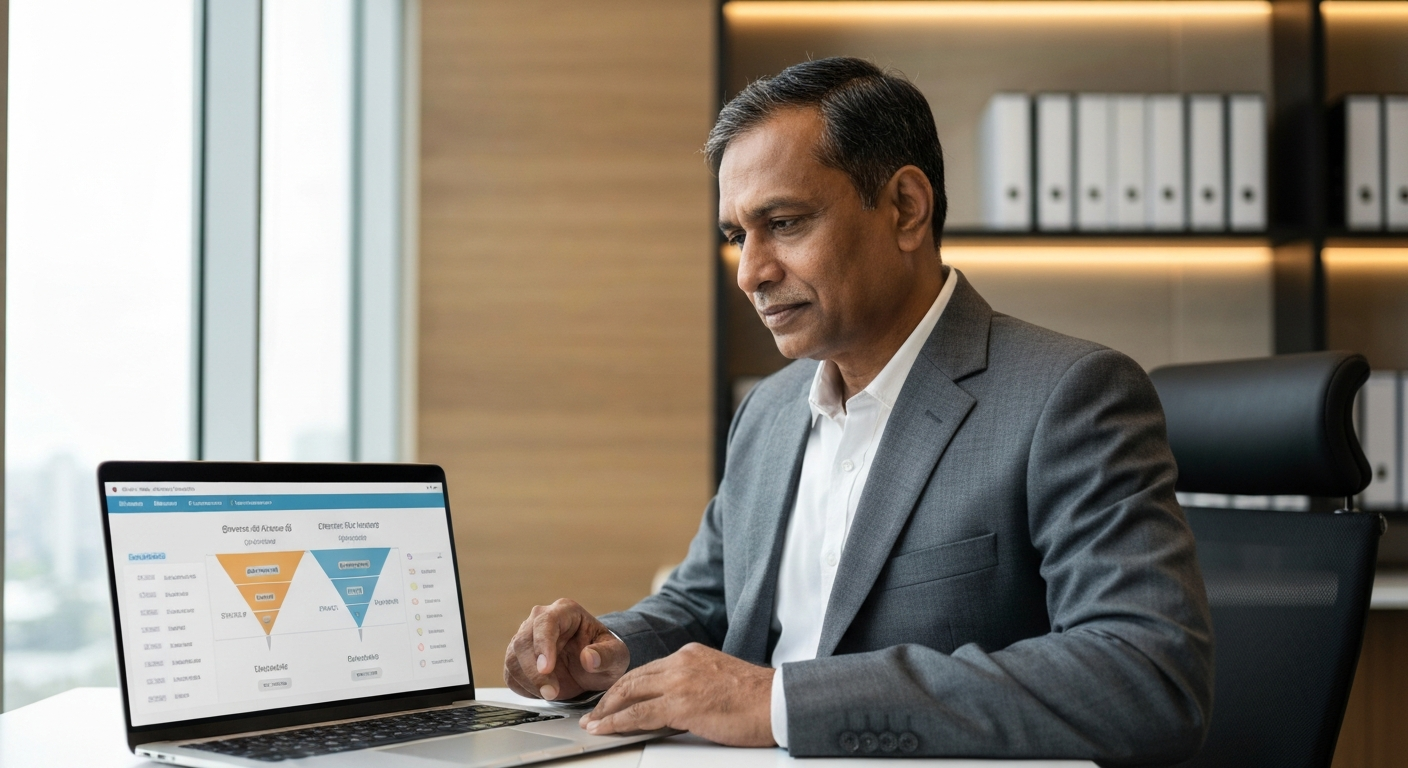
The 4-Stage Visitor-to-Customer Journey
Before we go into tactics, here is the framework that underlies everything in this guide:
- Stage 1 → Attract: The right visitor lands on your website
- Stage 2 → Convert: The visitor becomes a lead (enquiry, WhatsApp message, call, form submission)
- Stage 3 → Engage: The lead becomes a prospect through fast response, conversation, and trust
- Stage 4 → Close: The prospect makes a decision and becomes a paying customer
Every business that successfully turns website visitors into customers has a deliberate system for each stage. Most small businesses in Tamil Nadu have some version of Stage 1 (they're running ads or doing SEO, getting some traffic). Very few have a properly functioning Stage 2. Even fewer have any systematic approach to Stages 3 and 4.
The leakage is not at the traffic stage — it's at every stage after. Here's how to seal it.
Stage 1: Attract Visitors Who Are Actually Likely to Buy
The fastest way to improve your conversion rate is to change the quality of your traffic before you change anything on your website.
A visitor who lands on your site because they searched "how to reduce electricity bills in Chennai" is unlikely to buy your solar panel installation service today — they're in early research mode. A visitor who searched "solar panel installation cost Chennai 3BHK" is much closer to a purchase decision.
The difference between these two visitors is search intent — and it's the most underappreciated element of conversion strategy.
For organic search: Prioritise keywords that reflect active buying intent, not just topic interest. "Best digital marketing agency Chennai" has higher buyer intent than "what is digital marketing." Use Google Search Console to identify which keywords are currently bringing your traffic — and check whether those visitors are enquiring or just reading and leaving.
For paid ads: The tighter your targeting, the higher your intent. A Google Search Ad on "emergency AC repair Chennai" attracts people who need a repair today. A broad interest-based Facebook Ad targeting "home improvement enthusiasts in Chennai" reaches people who might — someday — consider an AC service. The first audience costs more per click; it converts dramatically better per rupee spent.
Stage 2: Convert Visitors Into Leads — The On-Site Conversion System
Assuming you're attracting the right visitors — people who genuinely need what you offer — here's what determines whether they enquire or leave.
Your Value Proposition Must Land in Five Seconds
The moment a visitor lands on your page, they make a rapid, largely subconscious decision: "Is this for me? Does this seem right? Should I keep reading?" If your headline is generic, your hero section is a full-screen stock photo of a handshake, and the first paragraph is about your company's "commitment to excellence" — they leave.
Your homepage headline must answer three questions immediately:
- What do you specifically do?
- Who specifically is it for?
- What specific result can they expect?
"We help Chennai retail businesses generate 40% more walk-in traffic through local SEO and Google Ads — in 90 days." That headline answers all three. A visitor who owns a Chennai retail business knows immediately whether to keep reading.
One Dominant Call to Action
Every page on your website should have one primary action you want the visitor to take — and it should be visually impossible to miss.
Not a menu of six options. Not a vague "Learn More" link buried at the bottom. One clear, specific, compelling button that tells the visitor exactly what happens when they click it:
- "Book a Free 20-Minute Strategy Call"
- "WhatsApp Us — We Respond in 60 Seconds"
- "Get Your Free Website Audit"
Specificity converts. Vagueness loses. The more clearly you describe what the visitor gets by clicking, the lower the anxiety of clicking.
Frictionless Contact — Especially WhatsApp
For Tamil Nadu small businesses, WhatsApp is not just one contact channel — it is the contact channel. Most of your potential customers use WhatsApp every hour of the day. It is the path of least resistance between interest and conversation.
Every page of your website should have:
- A floating WhatsApp button (visible as the visitor scrolls, one tap to open a chat)
- Your phone number in the header — clickable, so it dials automatically on mobile
- A short enquiry form with no more than three to four fields for visitors who prefer forms
Stage 3: Convert Leads Into Prospects — Speed, Trust, and the First Conversation
A lead is not a customer. A lead is someone who raised their hand — they sent a WhatsApp message, filled your form, called your number. Between that moment and the moment they pay you, something has to happen that makes them choose you over every alternative, including doing nothing at all.
Response Speed Is a Conversion Variable
This is perhaps the most consistently underestimated conversion factor we encounter with Tamil Nadu businesses.
Research published in Harvard Business Review found that businesses contacting leads within five minutes of an enquiry were nine times more likely to convert them than those who waited even 30 minutes. In practice, most small businesses respond to enquiries hours later — if at all. The leads that seem to have "gone cold" are frequently leads that remained warm but moved on simply because someone else responded first.
The solution is not to hire someone to monitor WhatsApp 24 hours a day. The solution is automation. An AI-powered WhatsApp bot that responds within 60 seconds of every enquiry — acknowledging the lead, answering their initial question, and either qualifying them further or booking a time to speak — dramatically changes your conversion rate without adding headcount.
The First Conversation Is Everything
When a human on your team does speak to a new lead, the quality of that first conversation determines everything that follows. This is not a script — it's a mindset.
The first conversation should be more question-asking than pitch-delivering. Understand the lead's situation deeply before presenting a solution. A financial advisor who spends the first 20 minutes asking about a client's business, goals, and previous experiences with financial planning closes more deals than one who immediately launches into a product presentation.
Building Trust Before the Close
Between the first conversation and the purchase decision, trust needs to be built — especially for higher-value services or for leads who are still comparing options.
The most effective trust-building assets during this stage:
- Case studies with specific results: Not "we helped a Chennai business grow" — but "we helped a T Nagar electronics retailer increase Google enquiries by 3x in four months."
- Testimonials from relatable customers: A testimonial from a business owner who is similar to the prospect is significantly more persuasive than a general five-star review.
- Relevant content shared proactively: Sharing a genuinely helpful blog post or a case study relevant to their industry keeps your business front-of-mind.
- A clear, low-risk next step: Rather than asking for a large commitment immediately, design your sales process to have a low-risk next step — a free audit, a 30-minute consultation, a no-obligation proposal.
Stage 4: Convert Prospects Into Customers — The Follow-Up and Close System
This is where the majority of Tamil Nadu small business revenue is lost — not at the enquiry stage, not in the first conversation, but in the follow-up gap between initial interest and final decision.
The research is unambiguous: most sales require multiple touchpoints before closing. The National Sales Executive Association research on sales persistence shows that the vast majority of sales require five or more follow-ups after initial contact, yet most salespeople abandon the follow-up process after one or two attempts.
Build the Follow-Up Into the System, Not Into Willpower
A structured follow-up sequence removes the dependency on memory and availability:
- Day 0 (Enquiry received): Instant automated WhatsApp response — acknowledge enquiry, answer initial question, invite conversation
- Day 1: If no response, a warm follow-up message: "Hi [Name], just checking if you had any questions after my earlier message — happy to answer anything"
- Day 3: Value-add message — a relevant blog post, a case study, or a specific insight relevant to their enquiry
- Day 7: Soft close: "I wanted to follow up before the week closes — are you still looking at [service]? Happy to schedule a quick call if that helps"
- Day 14: Final reach-out — keeping the door open without pressure
This sequence, consistently executed for every lead, recovers a significant portion of leads that would otherwise have gone cold permanently.
Recovering Lost Visitors: The Power of Retargeting
Even with a well-optimised website, the majority of your visitors will not enquire on their first visit. Retargeting — showing ads specifically to people who have already visited your website — allows you to maintain visibility with this warm audience as they continue their research and move toward a decision.
For Tamil Nadu small businesses, retargeting typically works through:
- Meta (Facebook/Instagram) Pixel: A visitor who browsed your "SEO Services" page might see a Facebook ad the next day featuring a client testimonial and a "Book a Free Audit" offer.
- Google Display Retargeting: Your ads appear to past website visitors as they browse other websites in Google's Display Network.
- YouTube Retargeting: Short video ads shown to past visitors when they watch YouTube — particularly effective for service businesses.
The cost efficiency of retargeting is significantly better than cold acquisition advertising, because you're speaking to an audience that already knows your brand.
Social Proof — Your Silent, Always-On Sales Team
At every stage of the visitor-to-customer journey, social proof is doing quiet, continuous work — either building confidence or failing to.
A visitor on your website who sees 47 Google reviews averaging 4.8 stars, a page of specific client testimonials with photos and business names, and a case study showing results for a business similar to theirs — that visitor requires significantly less convincing than one who sees a generic website with no evidence of past results.
The most effective social proof for Tamil Nadu small businesses:
- Google reviews: The most trusted, because they're independently verified. Actively collect them and respond to every one.
- Named, specific testimonials: "Ramesh, Owner, Ramesh Textiles, Tirupur" with a specific result is ten times more powerful than an anonymous "5 stars — great service."
- WhatsApp screenshot testimonials: In Tamil Nadu's business culture, sharing genuine WhatsApp exchanges from happy customers (with permission) resonates deeply because it feels authentic and unscripted.
The Lifetime Value Play: From First Sale to Loyal Advocate
Most businesses obsess over acquiring new customers and almost entirely neglect what happens after the first purchase. This is a significant strategic error.
Research compiled by Bain & Company found that increasing customer retention by just 5% typically increases business profitability by 25–95%. Your existing customers are your warmest audience. They've already trusted you.
The conversion system doesn't end at the first sale — it extends into:
- Post-purchase follow-up: A WhatsApp or email message two to three days after service delivery signals that you care beyond the transaction.
- Structured re-engagement: Customers who haven't bought in 90 days — a trigger in your CRM sends a personalised message.
- Referral activation: Your happiest customers are a direct pipeline to new customers. A simple, direct ask builds a referral engine that runs alongside your paid marketing indefinitely.
Putting It All Together: Your Complete Conversion System
Here is the complete visitor-to-customer system, assembled from every stage:
The Attraction Layer
- Traffic sources targeted to purchase-intent keywords and audiences
- Retargeting campaigns for warm website visitors
The On-Site Conversion Layer
- Fast-loading, mobile-optimised website
- Specific, outcome-focused value proposition above the fold
- One dominant CTA per page — clear, specific, compelling
- Floating WhatsApp button and clickable phone number everywhere
The Lead Response Layer
- Instant automated WhatsApp response — within 60 seconds, 24/7
- Structured 7–14 day follow-up sequence for non-responding leads
The Trust-Building Layer
- Relevant case studies and testimonials shared proactively
- Value-add content delivered between conversations
- Low-risk next step in the sales process
The Close Layer
- Consistent, structured follow-up across 5+ touchpoints
- Clear, specific proposal or offer tailored to the lead's situation
The Retention Layer
- Post-purchase follow-up within 48–72 hours
- CRM-triggered re-engagement at 30, 60, and 90 days of inactivity
- Active referral programme with a direct ask
Each layer is connected. Each feeds the next. And the full system — when built deliberately and maintained consistently — turns the visitor-to-customer journey from a leaking pipe into a compounding growth engine.
Frequently Asked Questions
What's the single highest-impact change I can make today to improve my website's conversion rate?
Add a visible, tap-to-open WhatsApp button on every page of your website, combined with an automated WhatsApp response to every enquiry. For most Tamil Nadu small businesses, the biggest conversion gap is not the website design or the value proposition — it's the response time gap between enquiry and first human contact. Fixing this one element typically generates measurable improvement in conversion within the first week.
How many touchpoints does it take on average to close a customer?
It varies by industry, price point, and decision complexity — but research consistently shows that most sales require between five and eight meaningful touchpoints after the initial enquiry. This is why a three-message WhatsApp follow-up that stops at Day 3 is usually insufficient. A 14-day, multi-touchpoint nurture sequence that combines WhatsApp messages, value-add content, and a personal call converts significantly more leads than any single-message follow-up approach.
Is it better to focus on converting existing traffic or getting more traffic?
For most Tamil Nadu small businesses, fixing conversion is a higher priority than increasing traffic. If your website is converting at 0.5% and you double your traffic, you get double the low conversion — the underlying problem is unchanged. If you improve conversion from 0.5% to 2% on the same traffic, you've quadrupled your leads without changing your ad spend. Fix conversion first; then scale traffic to multiply the improved result.
How do I get leads from my website to actually answer my follow-up messages?
The key factors are speed, relevance, and channel. The first message sent within 60 seconds of enquiry has dramatically higher response rates than one sent hours later. Messages sent on WhatsApp (the channel the lead chose to enquire through) get higher response rates than emails. Messages that are specific to what the lead enquired about get higher response rates than generic "just checking in" messages. All three together — fast, relevant, right channel — produce the highest re-engagement rates.
What's a realistic conversion rate improvement I should expect from implementing these changes?
Businesses implementing a comprehensive visitor-to-customer system — including on-site conversion fixes, instant WhatsApp response, structured follow-up, and social proof — typically see enquiry rates increase by 50–150% from the same traffic, and lead-to-customer conversion rates increase by 20–40%. The range depends on how broken the existing system was and how consistently the new system is maintained.
Should I use a WhatsApp chatbot or a real person for initial lead response?
Both — in sequence. An AI-powered WhatsApp bot handles the first 60-second response: acknowledging the enquiry, answering the most common initial questions, and either qualifying the lead or booking a time for a human conversation. A real person takes over for the actual sales conversation. This hybrid approach delivers the speed of automation with the relationship quality of human interaction.
How important is video content for converting website visitors?
Increasingly important — particularly for service businesses where the relationship and the expertise of the people involved matters to the buying decision. A 90-second "meet the team" video, or a two-minute case study walkthrough, builds more trust in less time than an equivalent amount of text. For Tamil Nadu businesses targeting local consumers, videos in Tamil (or bilingual) significantly outperform English-only content for engagement and trust.
How do I measure whether my conversion system is actually working?
Track these four numbers monthly: (1) website visitors, (2) website-generated leads or enquiries, (3) leads converted to proposals or consultations, and (4) proposals converted to paying customers. Calculate the conversion rate at each stage. When you implement a change, the impact should appear in one of these four numbers within 30–60 days. If all four are tracked and improving, your system is working.
What's the difference between a lead and a prospect — and does it matter?
It matters practically. A lead has expressed some interest — they filled a form, sent a WhatsApp, or called. A prospect has had an initial qualifying conversation and has been confirmed as a genuine fit for your service. Managing leads and prospects differently — with different communication frequencies and content — is more efficient than treating all contacts the same. Your CRM should reflect these distinct stages in your pipeline.
I've implemented some of these changes but still not seeing results — what's usually wrong?
The most common reasons a conversion system underperforms: (1) the traffic source has low purchase intent — the right system can't compensate for fundamentally wrong-audience traffic; (2) the follow-up sequence is too short — stopping at two messages instead of five to seven; (3) the value proposition still isn't specific enough; or (4) the system isn't being maintained. Run through the four-stage checklist and identify which layer has the biggest gap — then fix one layer at a time.
Ready to Build Your Conversion System?
Traffic without a conversion system is money spent on a leaking funnel. But a well-built conversion system is a compounding asset. Every improvement at any stage multiplies the results from every other stage.
Revenue Mastery Consulting works with small businesses across Tamil Nadu to design and implement the complete visitor-to-customer journey — from traffic quality and on-site conversion to follow-up automation and customer retention.
Book a free conversion audit at revenuemasteryconsulting.com — we'll walk through your current funnel, identify your biggest leakage points, and show you exactly what to fix first.