AI Automation for Clinics in Chennai: Stop Losing Patients to Missed Calls and No-Shows
Chennai clinics are losing patients and revenue every day to missed calls, slow follow-up, and appointment no-shows. Learn how AI automation helps clinics recover patients, reduce no-shows by up to 50%, and fill their schedules — automatically.
Revenue Mastery Consulting
AI Automation Experts
If you run a clinic or hospital in Chennai — whether it is a general practice in Velachery, a dental clinic in Anna Nagar, a dermatology centre in Nungambakkam, or a multi-specialty hospital in Kilpauk — there is a very specific and very costly problem that is most likely happening in your practice right now without appearing anywhere on your financial reports. AI automation for clinics in Chennai is not a futuristic concept reserved for large hospital chains. It is a practical, affordable system that is already helping clinics across India recover patients lost to missed calls, eliminate no-shows through automated reminders, and fill their schedules without placing any additional burden on their already-stretched front desk teams. In this article, you will learn exactly what is costing your clinic patients and revenue every week, why the standard approach of hiring more receptionists does not solve the problem, and how AI automation fixes it — permanently and affordably.
The Problem Nobody Puts on the P&L
There are two silent revenue leaks inside almost every clinic in Chennai that do not show up in standard financial reporting — and both are significantly larger than most clinic owners realise.
Leak 1: Missed calls that are never recovered.
Leak 2: Booked appointments that turn into no-shows.
These two problems are not exceptional. They are the norm for clinics of every size across Chennai and Tamil Nadu. And together, they represent a consistent, monthly revenue drain that compounds silently, year after year.
One of the largest sources of patient loss happens at the very first interaction — a missed call, a delayed callback, an unanswered enquiry, a patient who never hears back.
Front desks are overloaded. Call queues grow during peak hours. Reception staff multitask constantly. Patients are placed on hold. Callbacks get delayed. Some enquiries are forgotten entirely.
From the clinic's perspective, this may feel like a temporary operational issue. From the patient's perspective, it feels very different. It feels like neglect. And patients today have alternatives. Healthcare has become increasingly competitive. Patients no longer wait passively for responses.
This is the environment Chennai clinics are operating in today. Understanding both leaks in detail is the first step to fixing them.
Revenue Leak 1: Missed Calls — The Scale of the Problem
Most clinic owners in Chennai estimate that their front desk answers the vast majority of calls. The actual data tells a very different story.
Across all practice sizes and specialties, 23% of calls to medical practices go unanswered — sent to voicemail, abandoned during hold, or disconnected. Solo practices have miss rates of 30% or higher, while large groups average 15–18%.
For a busy Chennai clinic receiving 60 calls a day, that is anywhere from 9 to 18 missed calls every single day. And when a call is missed, what happens next?
When a patient searches for a clinic on Google, they do not get one option — they get dozens. And if the first clinic they call does not answer, they immediately call the second. Then the third. Until someone picks up.
When patients reach voicemail, 62% hang up without leaving a message. They either call back later, call another provider, or simply do not address their healthcare need. Voicemail is not a safety net — it is a leak in your patient access pipeline. More than half of missed calls disappear entirely if they reach voicemail.
Patient acquisition data from 2025–2026 shows a brutal new reality: missed calls convert to appointments less than 5% of the time. When you miss a call and that patient does not leave a voicemail, there is a 95%+ chance they are already booking with your competitor.
The financial consequence of this is substantial. Missed calls cost clinics patients and revenue — just 2–3 unreturned calls a day can cost a clinic ₹3,000–₹10,000 monthly in lost opportunities, reputation damage, and reduced patient retention.
Recent industry analysis reveals that the average medical practice loses between $200,000 and $500,000 annually from missed calls alone, with some high-volume specialty practices experiencing losses exceeding $1 million per year.
For a Chennai context: if your clinic misses 10 patient calls per day and even 20% of those would have booked an appointment at ₹800 average visit value, that is ₹1,600 per day — or approximately ₹40,000 per month — in direct revenue lost before a single patient has even stepped through your door. And that does not account for lifetime patient value, referrals, or follow-up appointments.
Why the Front Desk Cannot Fix This Alone
Most practices do not ignore calls intentionally. The issue is capacity. Front desk teams juggle check-ins, insurance verification, co-pay collections, prior authorisations, paperwork, and in-person patient questions.
A clinic can receive up to 50 calls per day on top of all other tasks. A two-person front desk physically cannot answer 50 calls a day while also handling 30 in-person interactions, insurance work, and recall outreach.
Hiring an additional receptionist to cover calls feels like the obvious solution. But it is not a systems solution — it is a staffing band-aid. When the new receptionist is on lunch, on leave, or overwhelmed, missed calls return. The problem is not people. The problem is that the demand for call coverage now exceeds what any manual system can deliver consistently.
Call volume is not evenly distributed. 38% of daily calls occur during the first and last hours of clinic operation, creating predictable rush hours — and this is exactly when manual coverage fails most.
Revenue Leak 2: No-Shows — The Cost Hiding in Plain Sight
The second major revenue leak for Chennai clinics is appointment no-shows. A patient books an appointment. They confirm when asked. And then they simply do not show up.
In an Indian clinic dataset pulled across 47 specialist practices in late 2025, the average no-show rate for booked appointments was 19.4% — with the worst quartile above 26%. The average Indian specialist clinic loses 18–24% of booked appointments to no-shows.
If your clinic runs at a 20% no-show rate, you are handing a full day of capacity back to the void every single week.
Every Indian hospital and clinic owner knows this number by instinct, even if they have never measured it: somewhere between a quarter and a third of booked appointments simply do not show up. The patient forgets. The reminder SMS does not make it through. The receptionist was too busy to make confirmation calls. The clinic's own phone line was engaged when the patient tried to reschedule.
The reasons no-shows happen are almost always straightforward and preventable:
- Patient forgot the appointment — Most common reason. Preventable with automated reminders.
- Appointment booked weeks ago, patient lost track — Very common. Preventable with reminder sequences.
- Patient wanted to reschedule but could not reach the clinic — Common. Preventable with easy rescheduling via WhatsApp.
- Patient not sure of the time or doctor — Occasional. Preventable with automated confirmation including details.
- Patient found another clinic in the meantime — Occasional. Partially preventable with speed of response on follow-up.
No-shows are the tax that nobody puts on the P&L. The consult slot that does not fill. The dentist who walks into an empty chair at 4:30 PM.
For a Chennai specialist clinic with 30 appointments per day at ₹1,000 average consultation fee — a 20% no-show rate means 6 empty slots per day, ₹6,000 per day, and approximately ₹1,32,000 per month in revenue that was already on the books and then simply evaporated.
The clinics that get this right unlock 8–15% of monthly revenue that was already on the books.
The Chennai-Specific Context: Why These Problems Are Amplified Here
Chennai's private healthcare market is one of the largest and most competitive in India. The city has a dense cluster of private clinics, diagnostic centres, specialty hospitals, and multi-specialty chains across every locality — from Velachery and Adyar in the south to Anna Nagar and Kilpauk in the north and OMR in the east.
That density has two consequences for clinic owners:
Consequence 1: Patients have genuine alternatives. When a patient calls your clinic and the line is busy, Google Maps is already showing them the next three options within two kilometres. The days of a patient waiting patiently for a callback are over.
Consequence 2: After-hours enquiries are significant and mostly missed. Patients in Chennai research clinics and book appointments during evenings and weekends — after work, after school runs, after dinner. Most practices schedule one person to cover the phones during lunch. In Chennai, the equivalent dead zones are lunch hours and post-6 PM — when patient enquiry intent is often at its peak and front desk coverage is at its lowest.
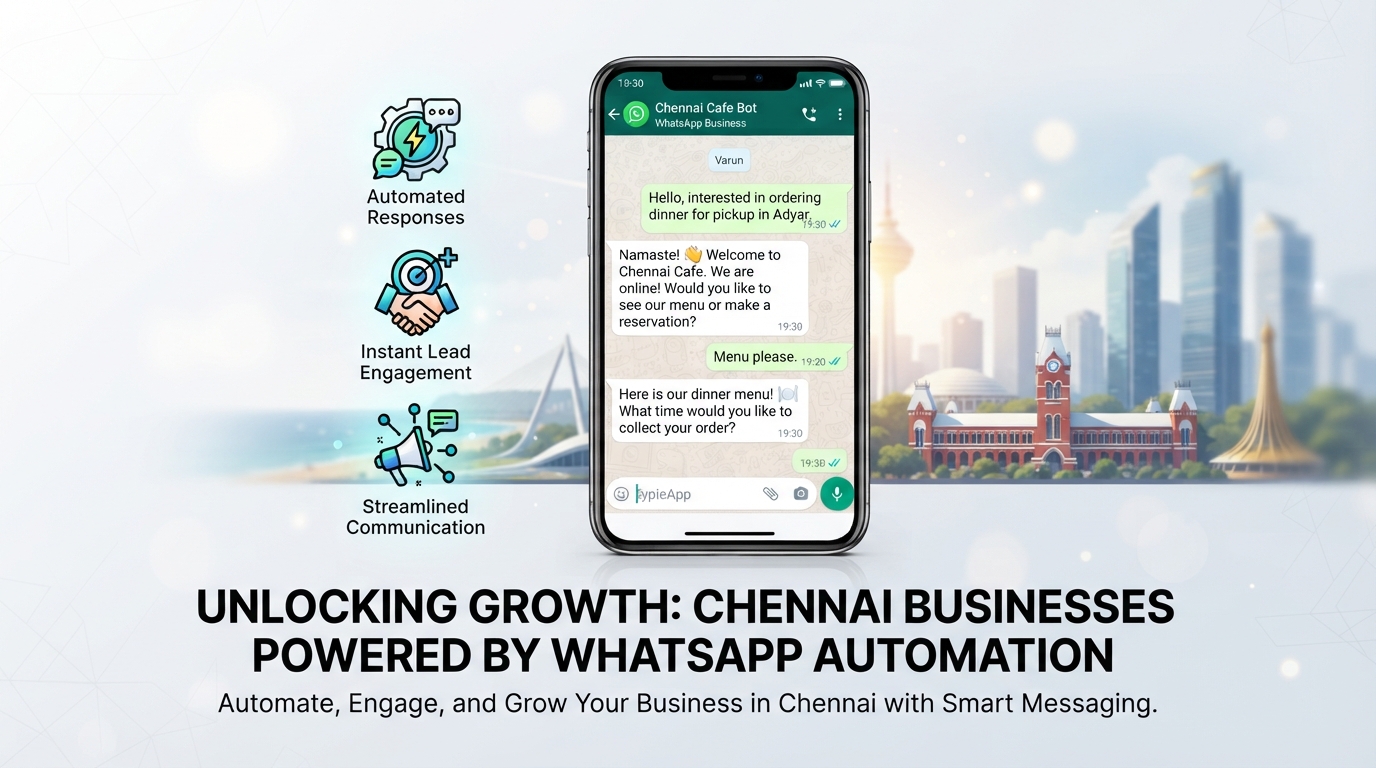
The WhatsApp dimension also makes Chennai unique. For Indian patients — and specifically for Chennai patients — WhatsApp is the communication channel they trust and use daily. WhatsApp is the only channel Indian patients actually read. This means that a WhatsApp message from your clinic — sent within seconds of a missed call — will be read, where a phone callback attempt or SMS will often be ignored.
How AI Automation Fixes Both Revenue Leaks — Completely and Permanently
Here is exactly what changes when a Chennai clinic implements AI automation through RevMax AI:
Fix 1: Every Missed Call Triggers an Automatic WhatsApp Text-Back
The moment a call is missed — whether at 9 AM during a rush or 8 PM after hours — the system instantly sends a WhatsApp message to the patient who called:
"Hello, this is [Clinic Name]. We are sorry we missed your call! How can we help you today? You can reply here to book an appointment or let us know what you need."
This single step recovers the majority of missed call opportunities. The patient gets an instant response. The conversation continues on WhatsApp — a channel they are already comfortable with. The front desk team sees the conversation in a shared inbox and can follow up when they are available, with all context already captured.
Platforms that combine 24/7 AI answering with WhatsApp follow-up, multilingual support, and CRM-style handoff stop missed patient enquiries by capturing appointment intent and triggering fast WhatsApp follow-up before the caller moves on to another provider.
Fix 2: No-Show Rate Drops by Up to 50% With Automated Reminder Sequences
The system sends appointment reminders automatically — across WhatsApp, SMS, or both — at the right intervals before every appointment. No staff member needs to remember, track, or manually send anything.
No-show reduction of 50–65% has been recorded with AI reminder calls versus 20–30% without reminders.
The exact reminder cadence and WhatsApp automation used by Indian clinics has been shown to cut no-show rates from the 18–24% average to under 8%.
The reminder sequence that works for Chennai clinics follows this structure:
- Confirmation — Immediately after booking via WhatsApp: Appointment details, doctor name, time, location
- First Reminder — 48 hours before via WhatsApp: Friendly reminder with one-tap confirm or reschedule option
- Second Reminder — 24 hours before via WhatsApp: Reminder with clinic address and what to bring
- Day-of Reminder — 2 hours before via WhatsApp: Final reminder with "We'll see you soon" message
- No-Show Follow-Up — 30 minutes after missed appointment via WhatsApp: Gentle rescheduling message — offer to book a new slot
Automation handles the outbound, tracks the confirmations and cancellations, and only surfaces exceptions to the human — the patient who ignored all three reminders and did not rebook. That is the person who needs a human call. Done right, your front desk spends 20 minutes a day on no-show recovery, not two hours.
Fix 3: Cancelled Slots Are Automatically Filled From a Waitlist
When a patient cancels, the system immediately identifies the next patient on the waitlist and offers them the available slot — automatically and without any staff coordination.
An AI system can automatically identify the best-fit patient from a waitlist based on appointment type, clinical urgency, patient availability, and proximity — and offer them the slot in real time via their preferred channel. What was a lost revenue slot becomes a recovered appointment. And the patient who needed to be seen sooner gets seen sooner.
Fix 4: After-Hours Enquiries Are Captured and Followed Up Automatically
When a patient fills out a form on your Google Business Profile listing, your website, or your Facebook page at 9 PM — the system sends them an automatic WhatsApp response within 60 seconds. The next morning, your team sees a list of confirmed appointments and warm leads already in the queue. Nothing was missed. Nobody had to stay late.
AI appointment booking lets patients schedule, reschedule, and cancel appointments in a natural conversation — any hour of the day — without a staff member ever picking up.
Fix 5: New Patient Enquiries Are Followed Up Instantly — Not the Next Morning
For enquiries coming in through Facebook Ads, Google Ads, or organic Google search, the system contacts the patient within 60 seconds — sending clinic information, introducing the doctor, and offering appointment time slots automatically.
Your clinic is not competing against the theoretical "best healthcare experience." You are competing against whoever answers their phone fastest.
What This Looks Like in Practice: A Chennai Clinic Before and After
Clinic Type: Dermatology and Skin Care Clinic — Nungambakkam, Chennai
Appointment Volume: 25 per day
Pre-automation situation:
- 12–15 calls received per day
- 3–4 missed during peak morning and lunch hours
- No automatic follow-up on missed calls
- Reminders sent manually via WhatsApp by the receptionist — inconsistently
- No-show rate: 21%
- Monthly revenue from empty slots: approximately ₹1,05,000 lost per month
Post-automation with RevMax AI:
- Every missed call triggers an instant WhatsApp text-back — 90% of those conversations continue and convert to bookings
- Automated 48-hour, 24-hour, and 2-hour reminder sequence runs for every appointment
- Cancelled slots automatically offered to waitlist patients
- No-show rate: dropped to under 9%
- Monthly revenue recovered: approximately ₹60,000–₹75,000 per month from the same appointment slots
- Front desk team freed from reminder calls — now focused on in-clinic patient experience
The automation system costs a fraction of what was being lost monthly to no-shows and missed calls. The payback is immediate and measurable.
The 6-Point Clinic Automation Audit: Is Your Chennai Practice Losing Patients Right Now?
Answer honestly. Every "yes" is a revenue leak.
- Do calls go unanswered during peak hours, lunch breaks, or after 6 PM?
- Is there no automatic system to follow up with patients who called and got no answer?
- Are appointment reminders sent manually — or not consistently at all?
- Is your no-show rate above 10%?
- When a patient cancels, does the slot often go unfilled for the rest of the day?
- Do new patient enquiries from Google or Facebook wait until the next business day for a response?
If you answered yes to three or more — your clinic is losing a measurable and recoverable amount of revenue every single month.
What AI Automation Does NOT Mean for Your Clinic
This is worth stating clearly, because many clinic owners hesitate at the word "automation" thinking it means replacing their team or making patient communication feel robotic and impersonal.
The better question is: what happens when your receptionist cannot answer? For most clinics, the practical answer is a hybrid model: use human receptionists for walk-ins, sensitive conversations, payment coordination, and clinical judgement. Use AI for overflow, lunch-hour spikes, evenings, weekends, campaign responses, and missed-call recovery. Use WhatsApp follow-up for appointment confirmation, callback requests, directions, preparation instructions, and opt-out-safe reminders.
AI automation is not about replacing your front desk. It is about ensuring that your front desk team — who are already at capacity — never loses a patient enquiry or a booked appointment because they were managing something else at the same time.
AI adoption works best when it makes the human team faster, calmer, and better informed — not invisible.
The Cost of AI Automation for a Chennai Clinic — and the Real ROI
The investment in AI automation for a Chennai clinic is straightforward. A properly built missed-call recovery, appointment reminder, and patient follow-up system typically runs between ₹16,000 and ₹30,000 per month — depending on call volume, number of channels, and complexity of the workflows.
Current India market rates for production-grade AI automation land between ₹3 and ₹9 per connected minute. For a 1,200-appointment-per-month clinic running reminders, confirmations, and no-show follow-ups, the total monthly automation cost is typically lower than the loaded salary of a single receptionist — before counting the recovered revenue from cutting no-shows. The unit economics are genuinely straightforward.
Here is the ROI calculation for a typical mid-size Chennai clinic:
- Daily calls received: 50
- Calls missed per day: 12 (24%) → 1–2 (recovered by text-back)
- Patients lost to missed calls per month: ~72 → ~6
- No-show rate: 20% → 8%
- Monthly appointments lost to no-shows (from 600 booked): 120 slots → 48 slots
- Recovered appointment revenue (at ₹1,000/slot): — → ₹72,000/month
- Recovered missed-call patients (conservative 15% convert): — → ~10 new patients/month = ₹10,000
- Total revenue recovered per month: — → ₹82,000+
- Cost of automation: — → ₹20,000–30,000/month
- Net monthly gain: — → ₹52,000–₹62,000
Clinics that have adopted AI tools for patient follow-up and no-show reduction report meaningful results. Multiple healthcare studies show no-show rate drops of 20–50% after introducing predictive reminders and automated rescheduling.
How Revenue Mastery Consulting Builds This System for Chennai Clinics
Revenue Mastery Consulting (RMC) is Chennai's dedicated AI automation agency, and the RevMax AI platform is specifically built to solve the revenue leakage problems that Chennai clinics face every day.
RMC does not install a generic chatbot and walk away. The process starts with a full audit of your clinic's current patient communication flow — how calls come in, how enquiries are handled, how appointments are confirmed, and where patients are being lost. The automation system is then built to close those specific gaps.
Here is what the RevMax AI system delivers for Chennai clinics:
- Instant missed-call WhatsApp text-back — every missed call recovered with a personalised message within seconds
- Automated appointment confirmation — sent via WhatsApp the moment a booking is made
- Multi-step reminder sequence — 48-hour, 24-hour, and 2-hour reminders sent automatically for every appointment
- Waitlist auto-fill — cancelled slots immediately offered to the next waiting patient
- After-hours enquiry capture — every Google, Facebook, or website enquiry responded to within 60 seconds, 24/7
- Patient re-engagement sequences — patients who have not visited in 60–90 days automatically invited back
- Google review automation — review requests sent automatically after every successful appointment, building your clinic's online reputation without manual effort
- Shared team inbox — every patient conversation visible to the clinic team, with full context, from any device
The result is a clinic that never loses a patient to an unanswered phone, never lets a booked appointment disappear without a fight, and never relies on a single receptionist's availability to deliver a professional, responsive patient experience.
To see how RevMax AI works specifically for your clinic, visit revmaxapp.com. To book a free strategy call with Revenue Mastery Consulting, visit revenuemasteryconsulting.com/ai-automation-agency-chennai.
FAQ: AI Automation for Clinics and Hospitals in Chennai
What is AI automation for clinics in Chennai?
AI automation for clinics in Chennai means using intelligent software systems to automatically handle patient communication tasks — including responding to missed calls via WhatsApp, sending appointment reminders, following up with enquiries, filling cancelled slots from a waitlist, and capturing after-hours bookings — without any manual effort from your front desk team.
How many calls does a typical Chennai clinic miss per day?
Across all practice sizes and specialties, 23% of calls to medical practices go unanswered. Solo practices have miss rates of 30% or higher. If your clinic receives 50 calls daily, you are likely missing 10–15 opportunities to serve patients, schedule appointments, and generate revenue every single day.
What is the average no-show rate for clinics in India?
The average Indian specialist clinic loses 18–24% of booked appointments to no-shows. With proper automated reminder sequences via WhatsApp, this can be reduced to under 8% — recovering a significant portion of monthly revenue that is currently lost to empty appointment slots.
Will AI automation replace my receptionist?
No. AI automation handles overflow, after-hours enquiries, missed calls, and reminder sequences — the tasks that overwhelm your front desk or fall through the cracks when your team is busy. Your receptionist continues to manage in-clinic patients, complex queries, and sensitive conversations. Automation makes your team more effective, not redundant.
How long does it take to set up AI automation for a Chennai clinic?
A basic missed-call recovery and appointment reminder system can be live within 7–14 days. A full system including after-hours enquiry handling, waitlist management, patient re-engagement sequences, and Google review automation typically takes 3–4 weeks, depending on the clinic's complexity and existing tools.
How much does AI automation cost for a clinic in Chennai?
A properly built AI automation system for a Chennai clinic — covering missed-call text-back, appointment reminders, after-hours enquiry handling, and patient follow-up — typically runs between ₹16,000 and ₹30,000 per month. For most clinics, the revenue recovered from reduced no-shows and recovered missed-call enquiries significantly exceeds this cost within the first month.
Which types of clinics in Chennai benefit most from AI automation?
General practice and family clinics, dental clinics, dermatology and skin care centres, orthopaedic clinics, gynaecology and fertility clinics, diagnostic centres, physiotherapy practices, eye care centres, and multi-specialty hospitals all benefit significantly — because each of these clinic types has high call volumes, time-sensitive patient needs, and significant revenue impact from missed calls and appointment no-shows.
Does the system work in Tamil and other regional languages?
Yes. A properly configured WhatsApp automation system for Chennai clinics can send messages in Tamil, English, or both — depending on the patient's language preference. Regional language support is a critical component of an effective patient communication system in Tamil Nadu.