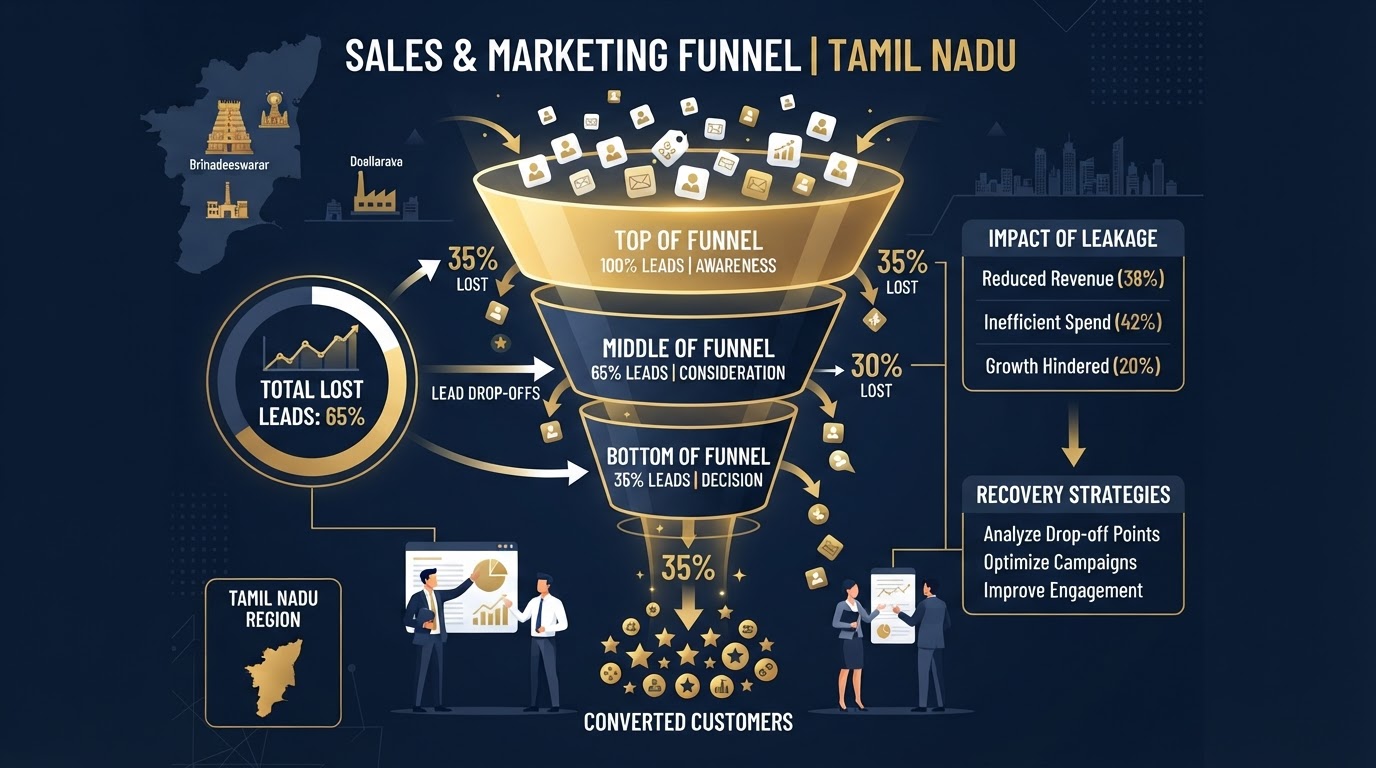
Why 90% of Indian Restaurants Use WhatsApp Only for “Table Hai Kya?” — And How the Other 10% Are Printing Money With It
Most Indian restaurants use WhatsApp only for basic replies while losing lakhs to Zomato commissions, no-shows, and zero repeat orders. Learn how WhatsApp automation builds a direct revenue channel in 48 hours.
Revenue Mastery Consulting
AI Marketing Experts
Every Indian restaurant owner has WhatsApp on their phone.
Most use it to answer “table available hai kya?” and forward orders to the kitchen team.
A small but growing number of restaurant and cloud kitchen operators are using the exact same platform to take direct commission-free orders, cut no-shows by 40 to 55%, build a repeat customer base that visits 3 to 5 times more frequently, and generate 3 to 5× returns on every rupee spent on WhatsApp marketing.
90% of Indian restaurants use WhatsApp only for basic replies. The restaurants winning in 2026 use WhatsApp as a full marketing channel — broadcasting offers to 500+ customers, taking direct orders with zero commission versus Swiggy's 27%, sending personalised birthday messages, and building a loyal customer database.
This article is for every restaurant owner, cloud kitchen operator, café founder, and QSR manager who knows WhatsApp is important but has not yet built a system around it. You will learn exactly where your revenue is leaking, how the automation works step by step, and what real food businesses across India have earned after putting it in place.
The Triple Threat Killing Food Business Margins in 2026
Restaurant owners, QSR brands, and cloud kitchen operators face a triple threat in 2026: escalating ad costs, high platform commissions often at 18 to 28%, and highly sensitive customer expectations.
These three problems are connected. And WhatsApp automation is the single infrastructure change that attacks all three simultaneously.
Problem 1: Zomato and Swiggy Are Taking More Than a Quarter of Every Order
Indian cloud kitchen operators are bleeding 18 to 28% per order to Zomato and Swiggy commission, 4 to 7% to payment gateways, and another 2 to 3% to discount sharing.
Let us put that in concrete numbers. The average ticket size for a 2026 Indian cloud kitchen is ₹420. On a Zomato or Swiggy order, you net roughly ₹290 after commission, payment fees, and discount sharing. On a direct WhatsApp order with UPI checkout, you net roughly ₹400 — ₹110 extra per order. At 60 orders per day per kitchen, that is ₹2 lakh per month in saved margin per location.
₹2 lakhs per month. Per kitchen. Recovered not by selling more food — by selling it through a different channel.
The operators who survive 2026 are the ones who shift 30 to 40% of orders to direct WhatsApp ordering before the next aggregator pricing round.
This is not about leaving Zomato and Swiggy. Get listed on aggregators for initial discovery and orders. Simultaneously, set up direct WhatsApp ordering to build commission-free revenue over time. Use the platforms for customer acquisition. Use WhatsApp to own the repeat customer relationship — where the real margin lives.
Problem 2: No-Shows Are Emptying Your Most Profitable Tables at Your Peak Hours
Restaurants bleed margin on three things: empty seats at peak slots from no-shows, passive re-order volume from existing customers, and silent bad reviews that cost future traffic. WhatsApp hits all three at a per-message cost lower than what aggregators charge per order. A 20-seat restaurant with a 10% no-show rate at Saturday dinner peak is four empty seats at the highest-margin hour.
Four empty seats on a Saturday night. That is not just lost revenue for one evening. Every empty seat at peak time is a missed opportunity to serve a paying customer who wanted your table and was given to a no-show who forgot to cancel.
The gap between when a guest reaches out and when the restaurant responds is the single biggest, cheapest revenue leak in food service — and it is exactly what the WhatsApp Business API closes.
Problem 3: Your Regulars Are Not Coming Back — Because Nobody Is Asking Them To
Customer retention is the highest-ROI activity in restaurant marketing — acquiring a new customer costs 5 to 7 times more than retaining an existing one, yet most restaurant owners spend the majority of their marketing budget on acquisition.
A customer visits your restaurant, has a wonderful experience, and then hears nothing from you for three months. No follow-up. No personalised offer. No birthday message. No “your favourite biryani is back on the menu” broadcast. Nothing.
Loyalty card in wallet, an app nobody installs, email nobody reads. Regulars get nothing back for loyalty — then leave for the new place down the street. WhatsApp replaces the reservation reminder, the SMS order confirmation, the post-meal feedback form, and the loyalty card — all in one channel the customer already uses.
The fix is not complicated. Indian restaurants using structured WhatsApp marketing report 15 to 25% increases in repeat visits within 3 months. The difference between restaurants that see this result and those that do not is whether they have a system that communicates with existing customers automatically — or whether they rely on the customer to remember them on their own.
The 6 WhatsApp Flows Every Restaurant and Cloud Kitchen Needs Running in 2026
Here is the complete automation stack that RevMax AI WhatsApp Studio deploys for food businesses — from the first customer message to the loyalty programme that keeps them coming back for years.
Flow 1: Reservation Confirmation and No-Show Elimination
When a booking is made, a WhatsApp confirmation goes out with the map and contact details, followed by a reminder 2 hours before with a “Still coming?” button. No-shows drop 40 to 55%.
This is the single highest-impact flow for dine-in restaurants. Here is why it works so well. A confirmation message alone reduces no-shows. A confirmation plus a 2-hour reminder with a one-tap response button makes cancellation frictionless — customers who genuinely cannot make it will cancel, releasing the table for someone on your waitlist. The no-shows that remain are reduced to genuine emergencies rather than forgotten bookings.
A 32-outlet casual-dining cohort across 16 Indian cities with ₹140 crore in revenue saw reservation show-up rates climb from 67% to 91% — a 24-percentage-point improvement representing over 1 lakh extra show-ups per year — along with repeat visits within 60 days climbing from 22% to 41%, average bill increasing by ₹240, and an ROI of ₹6.40 per ₹1 of message spend, translating to ₹18.6 crore in annual revenue lift.
That is not a hypothetical projection. That is what 32 outlets measured over a defined period after implementing WhatsApp automation across their reservation and retention flows.
Flow 2: Direct WhatsApp Ordering — Commission-Free Revenue
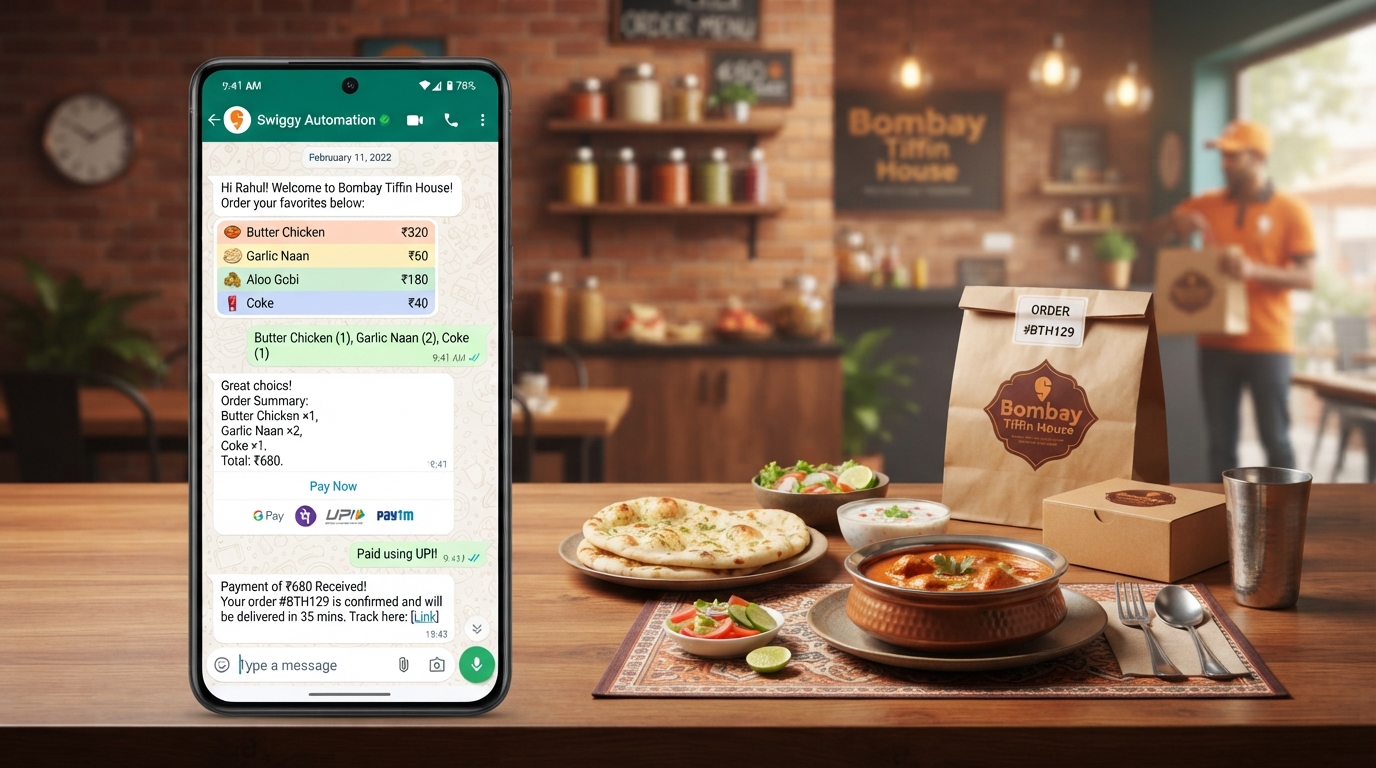
With WhatsApp Business API, food businesses can deploy AI-powered chatbots to take orders 24/7 by displaying menus and collecting order details, accept payments in-chat through integrated payment links, and send automated order confirmations with itemised receipts.
The flow is seamless from the customer's perspective. A customer messages your number. The AI greets them, presents your menu with photos, takes their order, sends a UPI payment link, confirms payment, and dispatches the order to your kitchen — all inside WhatsApp, in under 3 minutes.
No app download. No separate website. No aggregator taking a cut. Just a conversation in an app the customer already has on their phone.
KFC India's WhatsApp bot processed over 115,000 orders within the first six months of launch. Orders completed via WhatsApp had 30% lower bounce rates compared to website ordering, and repeat orders through WhatsApp customers were 18% higher than regular app users.
That last number — 18% higher repeat orders from WhatsApp customers — is the most important metric for any food business focused on profitability. WhatsApp captures the diner the aggregator never lets you reach, then keeps them with direct reorders and opted-in offers that skip the commission entirely — which is where a cloud kitchen's real margin lives.
Flow 3: Peak Hours and Missed Order Recovery
Research shows that 25 to 30% of orders are missed or delayed during peak hours due to chaos, translating to ₹15,000 to ₹50,000 in lost revenue monthly for an average cloud kitchen.
During peak hours — Friday evenings, weekend lunches, IPL match nights — phone lines are busy, staff are stretched, and messages on WhatsApp go unread for 20 to 40 minutes. By the time someone replies, the customer has ordered from another kitchen.
Restaurant owners using WhatsApp automation see 40% more orders during peak hours, and average order value increases by 25% when customers can engage conversationally.
AI-powered automation does not get overwhelmed during peak hours. Whether 5 customers message simultaneously or 500, every single one gets an instant, personalised response within 2 seconds. During your busiest hours — when every order matters most — the system performs at its best, not its worst.
Flow 4: Post-Meal Follow-Up, Feedback, and Google Reviews
Two hours after the bill is closed, the customer receives a WhatsApp message: “How was dinner? Rate us 1 to 5 stars.” A rating of 5 triggers a request for a Google review. A rating of 3 or below routes the conversation to a manager with the full order details for immediate outreach.
This single flow does three things simultaneously. It collects genuine customer feedback before the experience fades from memory. It intercepts unhappy customers before they leave a public negative review — giving your team a chance to make it right. And it converts happy customers into Google reviewers while their meal is still fresh.
The post-meal feedback flow redirects 5-star ratings to a Google review intent. Google review volume jumps 3 to 5 times within the first 90 days of launching this flow.
For any restaurant business in India where Google reviews directly influence discovery and foot traffic, a 3 to 5× increase in review volume within 90 days is a significant competitive advantage — earned not by asking staff to remember to prompt customers, but by an automated message that fires every single time a bill is paid.
Flow 5: Re-Order Reminders and Loyalty on WhatsApp
Customers who have not visited in 30 days receive a personalised re-engagement offer via WhatsApp — all without anyone in your team manually managing campaigns. A customer who orders paneer dishes exclusively should receive paneer-focused offers, not chicken promotions.
This is what separates WhatsApp loyalty from the generic loyalty card gathering dust in a customer's wallet. The system knows what each customer ordered last time, when they last visited, and what their favourite items are. Re-engagement messages are personalised to that data — not a generic discount blast sent to everyone at once.
A restaurant spending ₹5,000 per month on WhatsApp campaigns typically generates ₹15,000 to ₹25,000 in attributable revenue from repeat visits and reactivated lapsed customers.
That is a 3 to 5× return on every rupee spent — from customers who already know your food and trust your brand, not cold new customers acquired through expensive ads.
WhatsApp customers typically spend 20 to 30% more over time because of the personal relationship. When you communicate consistently and personally with a regular customer — birthday messages, personalised offers, first access to new menu items — they do not just visit more often. They spend more per visit and they refer people to you.
Flow 6: Special Occasion and Festival Broadcasts
Stored date of birth and anniversary data triggers an automatic WhatsApp message on the day with a gift or discount.
For a dine-in restaurant, a birthday message with a complimentary dessert or a special occasion discount is one of the highest-converting campaigns available. The customer feels remembered. The gesture is personal. And the conversion rate — because it arrives on the exact day someone is already thinking about where to celebrate — is dramatically higher than a generic promotional broadcast.
Reward customers for trying new menu items, ordering during off-peak hours, or increasing their order value — not just for spending more. Create seasonal loyalty challenges around Diwali, Holi, or regional festivals that drive engagement without blanket discounts.
Festival campaigns — Diwali special thali, New Year's Eve reservations, Eid feast packages — broadcast to your opted-in customer list deliver some of the highest engagement and conversion rates of any marketing format available to Indian food businesses. Indian restaurants using WhatsApp marketing report 40% higher repeat visit rates, 85 to 95% message open rates, and 3 to 5× ROI compared to traditional SMS and email marketing.
Real Case Studies: What Food Businesses Are Earning
Case Study 1: KFC India — Direct WhatsApp Ordering at Scale
KFC India became a leading model for restaurants using chatbots to simplify food ordering at scale through messaging. Their WhatsApp bot processed over 115,000 orders within the first six months of launch. Orders completed via WhatsApp had 30% lower bounce rates compared to website ordering, and repeat orders through WhatsApp customers were 18% higher than regular app users.
Case Study 2: 32-Outlet Casual Dining Chain — Full WhatsApp Automation
A 32-outlet casual-dining cohort with ₹140 crore in revenue across 16 cities deployed WhatsApp automation across reservations, loyalty, and post-visit flows. Results: reservation show-up rate climbed from 67% to 91%, repeat visits within 60 days jumped from 22% to 41%, average bill increased by ₹240, NPS improved from 4.1 to 4.7, support tickets per 10,000 covers dropped from 22 to 4, and ROI was ₹6.40 per ₹1 of message spend — translating to ₹18.6 crore in annual revenue lift.
Case Study 3: Network of Clinics (No-Show Benchmark for Food Businesses)
Across documented restaurant networks, restaurants win on WhatsApp through four flows: reservation confirmation and 2-hour reminder that cuts no-shows 40 to 55%, one-tap re-order for regulars that delivers 30 to 50% repeat-order lift, post-meal feedback leading to reviews or escalation, and loyalty and special-occasion messages.
Case Study 4: Independent Restaurant — Direct Order and Commission Saving
Tracking direct orders via WhatsApp versus Swiggy and Zomato, and calculating the 25 to 30% commission saved on orders shifted from aggregators to WhatsApp, is how food businesses are measuring the true margin impact of WhatsApp automation. A restaurant shifting just 15% of its delivery orders to direct WhatsApp at a ₹500 average ticket recovers ₹75 to ₹150 per shifted order in commission savings alone — before counting the revenue from repeat customers built on the direct channel.
The Revenue Math for Your Restaurant or Cloud Kitchen
Let us make this concrete for a cloud kitchen doing 60 orders per day.
Your current situation:
- 60 orders per day, ₹420 average ticket = ₹25,200 daily gross
- 100% orders through aggregators at 23% average commission = ₹5,796 paid to aggregators per day
- Monthly commission paid to aggregators: ₹1,74,000
- No-show rate for reservations (if dine-in): 20%
- Repeat customer visit rate: 22% within 60 days
After RevMax AI WhatsApp Studio:
- Shift 35% of orders to direct WhatsApp — based on documented cloud kitchen benchmarks
- Direct WhatsApp orders: 21 per day at ₹110 saved commission each = ₹2,310 saved per day = ₹69,300 saved per month in commission
- No-show rate drops from 20% to 9% through reservation reminder flow — based on industry data
- Repeat customer visit rate within 60 days climbs from 22% to 38% through loyalty and re-engagement flows
- Average bill increases by ₹200 per WhatsApp customer through conversational upsells — based on documented benchmarks
- Festival and special occasion broadcasts generating 3 to 5× ROI on a ₹5,000 monthly campaign = ₹15,000 to ₹25,000 in additional revenue
Conservative monthly impact: ₹1.2 to ₹2 lakhs in recovered and grown revenue — from the same kitchen, same food, same location. Just a different customer relationship infrastructure.
Why the WhatsApp Business App Cannot Build Any of This
Every restaurant must choose between the free WhatsApp Business App and the WhatsApp Business API. For restaurants with fewer than 500 regular customers and a single location, the free WhatsApp Business App is a starting point. However, once you cross 500 customers or want to automate campaigns, the WhatsApp Business API becomes essential.
The Official API is what lets a restaurant move past the consumer WhatsApp Business app limits: automated replies at any hour, reservation and order flows with buttons and lists, broadcast of the daily specials to opted-in regulars, delivery and pickup confirmations, and review collection after the meal — all on an approved business number with a Green Tick path.
If you are managing customer communication through a personal phone that gets passed between staff, responding manually to every reservation enquiry, and sending broadcast messages to a saved contacts list — you are operating at the limit of what the free app allows. Everything above that limit requires the Official API.
RevMax AI WhatsApp Studio is built entirely on the Official WhatsApp Business API — giving you full automation, multi-agent team inbox, CRM integration, and compliant broadcast campaigns with zero ban risk, all live in 48 hours.
WhatsApp Automation Across Different Food Business Formats
| Business Type | Biggest Pain Point | Most Impactful WhatsApp Flow |
|---|---|---|
| Cloud Kitchen | Aggregator commission 18 to 28% per order | Direct WhatsApp ordering — saves ₹110+ per shifted order |
| Dine-In Restaurant | No-shows at peak hours, no repeat system | Reservation reminder — cuts no-shows 40 to 55%, loyalty broadcasts |
| QSR Chain | Order volume chaos during peak hours, no loyalty | AI ordering bot — 40% more orders captured at peak, repeat programme |
| Café or Bakery | Pre-orders for cakes, seasonal items, no follow-up | WhatsApp pre-order flow, seasonal broadcast to opted-in list |
| Tiffin Service | Daily menu communication, subscription renewals | Daily menu broadcast, automated renewal reminders |
| Catering Business | Enquiry follow-up, event confirmation, payment | AI qualification flow, quote + contract + deposit link inside WhatsApp |
| Multi-Brand Kitchen | Multiple brands, multiple order channels, chaos | Unified order management across all brands in one shared inbox |
What RevMax AI WhatsApp Studio Delivers for Food Businesses
RevMax AI WhatsApp Studio is a done-for-you WhatsApp automation system built on the Official WhatsApp Business API — configured specifically for your restaurant, cloud kitchen, café, or food business. Revenue Mastery Consulting builds the complete system and has it live in 48 hours.
Everything included:
- ✅ Official WhatsApp Business API — zero ban risk, full Meta compliance
- ✅ AI-powered ordering chatbot — displays menu with images, takes orders, sends UPI payment link, confirms
- ✅ Reservation confirmation and 2-hour reminder with confirm or cancel button — cuts no-shows 40 to 55%
- ✅ Direct order flow — commission-free WhatsApp ordering with automated kitchen notification
- ✅ Post-meal feedback collection — 5-star ratings routed to Google review, low ratings routed to manager instantly
- ✅ Reorder reminder sequence — personalised by order history, sent at the right time
- ✅ Birthday and anniversary automation — triggered on the day with personalised offer
- ✅ Weekly specials and festival broadcast to opted-in customer list
- ✅ Loyalty programme integration — points balance, rewards, milestone messages on WhatsApp
- ✅ Win-back campaign — automated re-engagement for customers who have not ordered in 30 days
- ✅ Shared team inbox for all staff — kitchen, front of house, management — with full conversation history
- ✅ WhatsApp Green Tick verification — builds immediate customer trust
- ✅ Full analytics — direct order rate, no-show rate before and after, repeat visit lift, broadcast ROI
Frequently Asked Questions
Q: Can WhatsApp actually handle food orders, or is it just for enquiries?
A: Yes — full ordering including menu browsing, item selection, customisation, UPI payment, and kitchen notification can all happen inside a WhatsApp conversation. Many restaurants are now allowing customers to place orders directly through WhatsApp instead of relying only on food delivery apps — from neighbourhood cafés to cloud kitchens and restaurant chains, businesses are using WhatsApp to create faster and more direct customer experiences.
Q: Will customers actually use WhatsApp to order instead of Zomato?
A: Repeat customers absolutely will — especially when you make it easy and offer an incentive for direct ordering (like free delivery or a small discount). First-time customer acquisition still happens through aggregators. The goal is to shift the repeat order relationship to WhatsApp where you own the customer and keep 100% of the margin.
Q: How do I build a customer opt-in list for WhatsApp broadcasts?
A: Place a WhatsApp QR code on every table tent, receipt, and menu. When customers scan it, they are automatically added to your WhatsApp list and receive a welcome message with a first-visit discount. Restaurants using QR menus see 25 to 35% of diners opting in during their first visit.
Q: Can multiple staff members manage the WhatsApp number at the same time?
A: Yes. RevMax AI WhatsApp Studio's shared team inbox allows your entire team — kitchen, front desk, management — to access and manage the same WhatsApp number simultaneously, with full conversation history and assignment management. No more one phone being passed around during service.
Q: What about tiffin and subscription meal services — does this work for daily menus?
A: Yes. The retention playbook for tiffin, dabba, and meal-subscription services includes daily menu broadcasts, count-lock messages that reduce food waste, skip or pause flows, delivery confirmations, and a 3-step renewal ladder with UPI payment integration.
Q: How quickly will I see results?
A: No-show reduction is measurable within the first week as reservation reminders begin running. Direct order volume from existing customers builds over the first 30 to 45 days as your opted-in list grows. Repeat visit rate improvement becomes visible within 60 to 90 days as reorder and loyalty sequences begin cycling through your customer base.
Q: Is this only for large restaurant chains or can a single-outlet restaurant use it?
A: Chatbot technology is no longer limited to major brands. Cloud kitchens, cafés, quick-service restaurants, and independent eateries can now access chatbot solutions through affordable subscription models. RevMax AI WhatsApp Studio is deployed for single-outlet restaurants, independent cloud kitchens, and multi-location chains alike.
The Bottom Line
A restaurant does not need a generic chat tool — it needs WhatsApp wired into the parts of the business that leak money: empty tables, missed call-in orders, unconfirmed cash-on-delivery, and customers who never come back.
The Indian food industry is worth over ₹5.99 lakh crore and growing. The customers are there. The demand is real. The only question is whether you are capturing the full value of every customer who walks through your door — or whether you are leaving their repeat business, their referrals, and their loyalty on the table because nobody sent them a message.
The cloud kitchen brands that thrive in 2026 will not be the ones who outspend on Zomato discounts — they will be the ones who own the customer relationship on WhatsApp.
Your customers are already on WhatsApp. They are already using it to message friends, book services, and make decisions. The restaurants winning their loyalty are the ones communicating with them there — personally, consistently, and automatically.
The ones losing them to competitors are the ones still waiting for the phone to ring.
👉 Book a free demo with RevMax AI WhatsApp Studio — see how the system takes direct orders, eliminates no-shows, builds your repeat customer base, and goes live for your food business in 48 hours.
Related Reading:
- → Why Your Business Is Losing WhatsApp Leads Every Day — And the Permanent Fix
- → Why Your D2C Brand Is Losing ₹6 Lakhs Every Month to Abandoned Carts and COD Returns
- → WhatsApp Automation for Real Estate: How to Convert 3× More Leads
- → Why Your Clinic Is Losing Patients Before They Even Walk Through the Door
- → Why Coaching Institutes Lose 80% of Enquiries — And How to Fix It
About RevMax AI: RevMax AI is an AI-powered customer engagement platform developed by Revenue Mastery Consulting (RMC). WhatsApp Studio is a done-for-you WhatsApp automation system built on the Official WhatsApp Business API — helping restaurants, cloud kitchens, cafés, and food businesses across India take direct commission-free orders, eliminate no-shows, build repeat customer loyalty, and grow revenue without increasing headcount.