Google Ads vs SEO for Chennai Businesses: Which Should You Invest In First — and What Does the 2026 Data Actually Say?
Avinash N.U.
Founder & Chief Brand Strategist
Here is what you will learn: By the end of this article, you will have a data-backed answer to one of the most common questions in digital marketing — Google Ads or SEO first? You will understand the real ROI of each channel, what they actually cost for Indian businesses in 2026, when to choose one over the other, and why the highest-performing Chennai businesses use both together. Every claim is supported by verified research.
Google Ads vs SEO is not a new debate — but the data that should inform your decision has changed significantly in 2026. Rising ad costs, AI-driven search disruption, and new conversion rate research have all shifted the calculus. This guide cuts through the noise with verified numbers so you can make the right decision for your specific business situation.
The One-Line Summary Before the Data
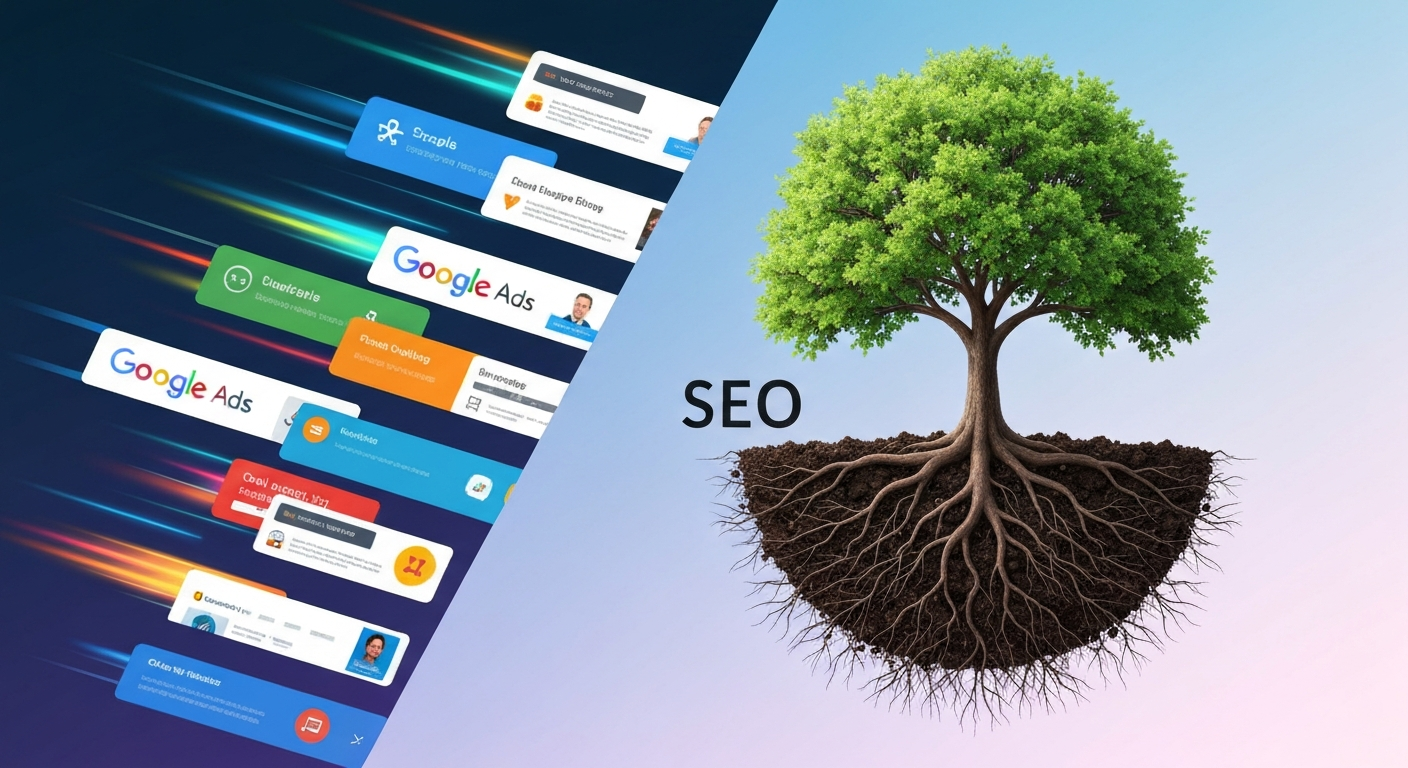
Think of it this way: Google Ads is renting a property. SEO is buying one. Renting gives you immediate access but you build no equity. Ownership takes longer and costs more upfront, but over time it tends to become your most valuable asset.
Section 1: The ROI Comparison — What the 2026 Data Shows
According to FirstPageSage's 2026 research, the median ROI for SEO over three years is 748%, compared to roughly 200% for PPC. SEO generates leads at $31 per lead compared to $181 for PPC — a 5.8x difference in cost efficiency.
According to 2025 data from CI Web Group, every dollar invested in SEO returned roughly $19.90 in value, compared to approximately $4.40 for paid ads.
The long-term ROI advantage of SEO is not marginal — it is structural. Here is why:
The critical difference is what happens after month 6. Google Ads costs stay the same every month. SEO costs stay the same but traffic increases. By month 12, your cost per lead from SEO drops 50 to 70% because existing articles continue ranking while new articles add incremental traffic.
One analysis showed that after two years, SEO content can reach an effective cost per lead under $7. Contrast that with paid search, where your cost per lead stays constant or rises as competition increases.
But here is the honest caveat that balances this data:
In the long run — 12 or more months — SEO almost always provides a higher ROI. However, in the first 3 months, Google Ads will likely have the better return. The decision is not which channel is better in absolute terms. It is which channel is better for your business right now, given your timeline and cash flow situation.
Section 2: What Google Ads and SEO Actually Cost in India in 2026
Google Ads Costs in India
In India, the average CPC for Google Search ads is ₹24 in 2026, with competitive industries pushing this to ₹3,000+ per click. The average cost per click in India ranges from roughly ₹3 in low-intent ecommerce categories to over ₹450 in health and term insurance, with most service businesses sitting between ₹25 and ₹250 per click.
For Chennai businesses specifically, the industry-level breakdown matters far more than the national average:
- Real Estate: ₹40–₹120 per click
- Education: ₹15–₹45 per click
- Healthcare: ₹25–₹150 per click
- Legal / Finance: ₹1,500–₹3,000+ per click
- E-commerce: ₹5–₹15 per click
- Local Services: ₹5–₹50 per click
India CPCs are 70–85% lower than US averages due to lower auction competition and lower purchasing power parity. This means Indian businesses — including those in Chennai — have access to paid search at a fraction of the cost of Western markets. But costs are rising. Bid inflation in finance, healthcare, and B2B SaaS has been steady at 12 to 18% year over year since 2023.
A ₹30,000–₹50,000 per month budget is a practical starting point for most small businesses running Google Ads in India.
Critical reminder: This is the ad spend paid directly to Google. Management fees go to your agency or freelancer if you outsource campaign operations. These run ₹20,000 to ₹3,00,000 per month for retainer models, or 10 to 20% of media spend for percentage models.
SEO Costs in India
SEO does not charge per click — which is its fundamental structural advantage. You pay a fixed monthly fee for strategy, execution, and management, and traffic compounds over time without increasing variable cost.
For Chennai businesses, SEO retainers typically range from ₹15,000 per month for local SEO to ₹2,00,000+ per month for full national SEO programmes. Read our complete breakdown on Digital Marketing Pricing in Chennai.
Section 3: The Head-to-Head Comparison Table
| Dimension | Google Ads | SEO |
|---|---|---|
| Time to first results | 3–7 days | 3–6 months |
| Cost structure | Variable — pay per click | Fixed — traffic is free |
| Long-term ROI (3 years) | ~200% | ~748% |
| Traffic when you stop paying | Zero immediately | Continues for months |
| Trust signal to users | Lower (users skip ads) | Higher (organic credibility) |
| AI search visibility | Not applicable | Directly feeds GEO |
Section 4: When Google Ads Is the Right First Investment
- You need leads immediately: Google Ads' biggest advantage is speed.
- You are a new business with no organic authority: A new website has no domain authority. Paid search fills that gap while SEO builds.
- You are launching a time-sensitive promotion: A seasonal campaign needs immediate visibility.
- You are in a category with strong bottom-of-funnel search intent: Re-target decision-makers who've already visited your site.
- You want to test keywords before committing to SEO: Use Google Ads to test which keywords result in actual sales.
Section 5: When SEO Is the Right First Investment
SEO is the top priority when you have a horizon of 6 to 12 months and want to build a lasting digital asset. It is especially strong for local SMEs where local SEO offers the best ROI available, with visibility on Google Maps and the Local Pack.
SEO is also the correct first investment when:
- Your business operates in B2B with long sales cycles.
- Your ad budget is limited and the ROI on paid search in your category does not justify the spend.
- You want to build brand authority and trust alongside traffic.
- You are in a category where AI search is increasingly relevant — SEO feeds directly into GEO and LLM citation visibility.
Section 6: The Combined Strategy — Why the Best Chennai Businesses Use Both
Industry research shows that companies using both channels together see roughly 35–40% higher ROI than those using only one.
Here is the sequenced approach that works for most Chennai businesses:
- Phase 1 (Months 1-3): Activate Google Ads on your priority keywords to generate leads immediately. At the same time, launch your SEO strategy.
- Phase 2 (Months 4-9): Your first SEO content starts to rank. Gradually reduce Google Ads bids on keywords where your SEO is performing well, and reallocate to more competitive terms.
- Phase 3 (Month 10+): SEO carries the majority of traffic at a compounding and reducing cost per lead. Paid search remains active for high-intent keywords and retargeting.
Section 7: The AI Search Factor
AI search engines including ChatGPT, Perplexity, and Google Gemini are now driving a significant and rapidly growing share of research-stage queries. Unlike Google Ads, paid search does not appear in AI-generated answers. Unlike traditional SEO, AI visibility requires specific structural content optimisation (GEO and AEO).
The businesses investing in SEO and content now are simultaneously building their AI search visibility. The businesses investing only in paid search are building zero AI search presence.
Section 8: The Lead Follow-Up Layer
The channel that generates the lead matters far less than what happens in the first 5 minutes after the lead arrives. Research consistently shows that leads contacted within 5 minutes of enquiring are dramatically more likely to convert. Yet most Chennai businesses have no automated system to respond immediately.
RevMax AI closes this gap. Every lead generated by your Google Ads or SEO investment is engaged within minutes — automatically, via WhatsApp, SMS, or email, 24 hours a day, 7 days a week.
See RevMax AI in Action
Don't let your hard-earned leads go cold. Book a free demo to see how our automated follow-up system can maximize your ROI from both SEO and Google Ads.
Book a Free Demo