Why Your D2C Brand Is Losing ₹6 Lakhs Every Month to Abandoned Carts, COD Returns, and No Repeat Purchases — And How WhatsApp Automation Fixes All Three
Indian D2C brands lose lakhs every month to abandoned carts, COD returns, and zero post-purchase follow-up. Learn how WhatsApp automation recovers lost revenue automatically — without increasing ad spend.
Revenue Mastery Consulting
AI Marketing Experts
Your ads are working. Your traffic numbers look good. Your Shopify dashboard shows decent order volume.
But when you actually sit down and calculate your true monthly revenue — after abandoned carts, after COD returns, after customers who bought once and disappeared — the number is a fraction of what it should be.
This is the quiet crisis running under the surface of almost every Indian D2C brand in 2026. The leaks are not happening in your ads or your product. They are happening after the customer shows intent — in the gap between interest and purchase, between order placement and delivery, between first purchase and second.
WhatsApp automation closes every one of those gaps. This article will show you exactly where the money is leaking, what the numbers look like, and how D2C brands across India are recovering lakhs in monthly revenue by fixing their WhatsApp communication layer — without touching their ad spend.
The Three Revenue Drains Killing Indian D2C Profitability in 2026
Drain 1: Abandoned Carts — The Sale You Almost Won
Baymard Institute's long-running e-commerce research places the average documented online shopping cart abandonment rate at around 70%. For Indian D2C brands, cart abandonment rates average 60 to 80%.
That means for every 10 customers who added your product to their cart, 6 to 8 of them left without buying.
Here is what that looks like in practice. A scene plays out thousands of times a day across Indian D2C stores. A customer is scrolling in the evening, adds a moisturiser and a serum to her cart, gets to the checkout page — and then her phone rings. A delivery at the door, a work message, a toddler needing attention. She closes the tab. She fully intends to come back to it. She does not.
By the old rules of e-commerce, that sale is gone. An abandoned cart email might land in a promotions folder she checks once a week, if at all. But for a growing number of Indian D2C brands, that sale is not gone — it is just delayed by a few hours, recovered through a WhatsApp message the customer actually reads within minutes of receiving it.
The channel difference is everything. Average email open rates for D2C cart recovery sit between 5% and 8% in India. Promotional tab filtering, inbox fatigue, and the sheer volume of marketing emails mean your carefully written subject line never gets seen. WhatsApp open rates run at 98%. That is not a marketing claim.
Drain 2: COD Returns — The Order That Costs You Twice
COD still accounts for 45% of Indian D2C orders — down from 55% in 2024, but still a massive working capital drag.
India's e-commerce RTO rate averages 25 to 35% — roughly three times the global benchmark of 8 to 12%. The gap exists because of COD dominance, Tier 2 and Tier 3 address quality, and low buyer intent on impulse purchases.
Return to Origin happens when a shipment dispatched from your warehouse comes back to you undelivered. Every RTO order triggers forward shipping cost, return shipping cost, repackaging, and inventory holding — totalling ₹150 to ₹300 per order, before you count the marketing spend to acquire that customer in the first place.
During the festive quarter, COD orders returned at 58%. Prepaid? Under 15%. That is not a small difference — that is a different business. Every COD return costs you forward shipping, reverse shipping, repackaging, and the customer's trust.
Let us make this concrete. A D2C brand doing 5,000 COD orders per month with a 30% RTO rate is burning ₹3 to ₹5 lakhs every month on failed deliveries.
Drain 3: No Repeat Purchases — The Customer Who Bought Once and Vanished
Meta ad CAC rose 32% year-over-year — from ₹380 average in 2025 to ₹502 in 2026. Brands with a 25%+ repeat purchase rate have 3.4× higher profit margins than brands with under 15% repeat rate.
The average Indian D2C brand has no structured post-purchase communication. A customer buys, receives an order confirmation SMS, gets their product, and then hears nothing. No follow-up. No re-engagement. No replenishment reminder. No cross-sell.
Marketing automation is no longer optional for D2C brands in India in 2026 — it is the difference between brands that scale profitably and brands that burn cash on manual marketing. The average Indian D2C brand loses 70 to 80% of shopping carts to abandonment, sends the same email to every subscriber, and relies on manual WhatsApp messages for customer engagement.
All three of these drains share the same root cause: no automated WhatsApp communication layer connecting your store events to your customer's phone. RevMax AI WhatsApp Studio is that layer — and it runs automatically the moment you go live.
The WhatsApp Automation Stack Every D2C Brand Needs in 2026
Indian brands are now using WhatsApp to acquire new customers, recover abandoned carts, convert browse intent, and guide first-time buyers into repeat purchase journeys. According to an Economic Times report citing GoKwik data, 83% of orders generated through WhatsApp during the October to December festive quarter came from first-time buyers. Brands using WhatsApp marketing tools on GoKwik's network recorded median GMV growth 2.25× higher than brands that did not.
But the channel only performs when the right message reaches the right customer at the right moment. Here is every automation your D2C brand needs, and exactly how each one works.
Flow 1: Abandoned Cart Recovery
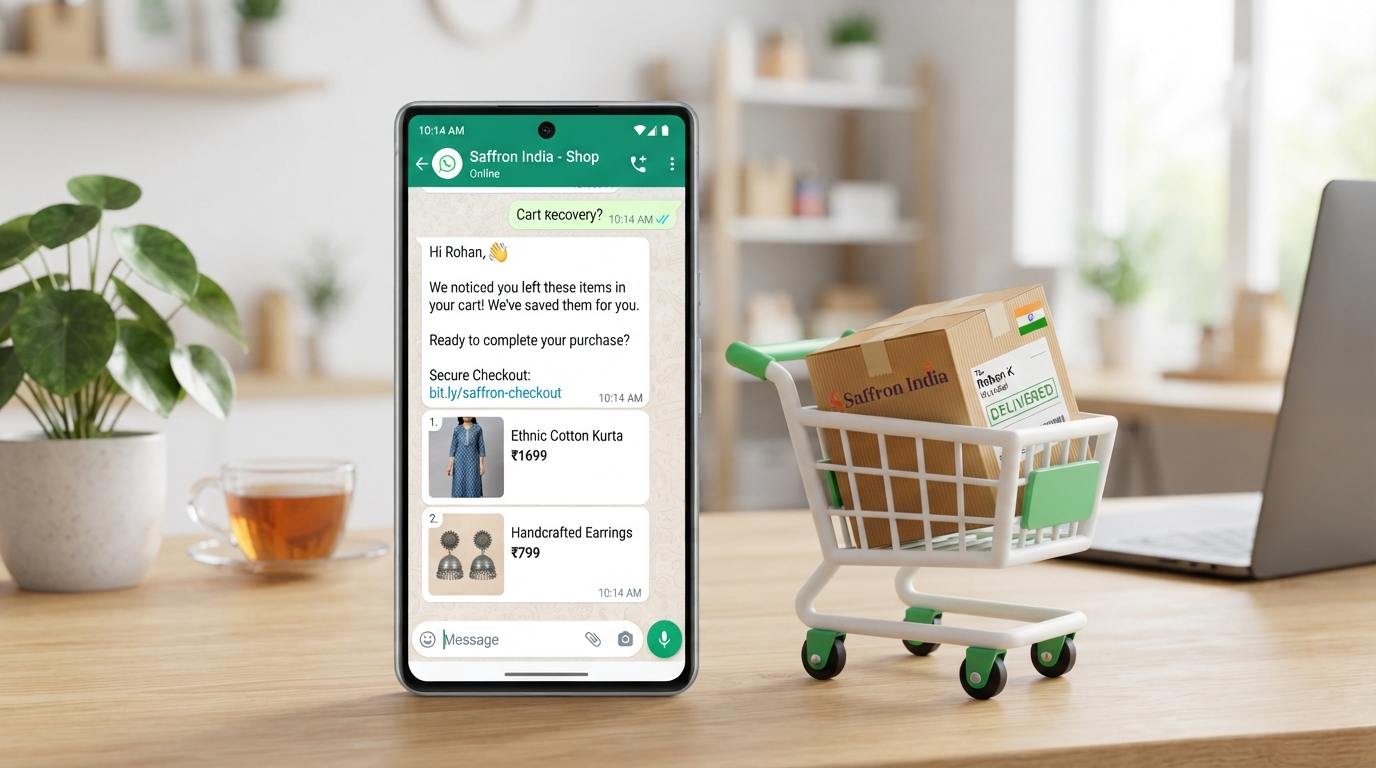
For D2C brands running Shopify, WooCommerce, or custom storefronts, integrating WhatsApp abandoned cart recovery is one of the fastest ROI improvements available. When a customer with a known WhatsApp number adds items to cart but does not complete purchase, a WhatsApp marketing automation trigger fires within 30 to 60 minutes, sending a personalised message referencing the specific products left in cart, along with a direct purchase link.
For Indian D2C brands, a structured multi-stage WhatsApp flow typically recovers a significantly higher share of abandoned carts than email alone. A well-structured WhatsApp cart recovery flow includes three stages: a gentle reminder without a discount sent around 1 hour after abandonment — catching customers who simply got distracted — a helpful check-in message around 24 hours later that invites questions rather than pushing a sale, and a time-bound incentive offer around 48 hours later for customers who have not responded to the first two messages.
Message 1 (1 hour after abandonment): Product name, image, price, and a one-tap checkout link. No discount yet. No pressure. Just a clean, personal reminder that feels like it came from someone who noticed they left something behind.
Message 2 (24 hours): A soft check-in. Invite a question. Add a genuine reason to act — a low-stock note if true, a delivery timeline if relevant. The reply trigger opens a support conversation that a chatbot or agent can handle.
Message 3 (48 hours): The offer message — a personalised discount code with a hard expiry — sent only to people who opened Message 1 or 2 but still did not buy. Sending a discount to everyone from Message 1 trains customers to abandon carts on purpose, waiting for the coupon.
Automated customer journeys such as abandoned cart reminders deliver average click-through rates of 11.1%, compared with 2.6% for broadcast campaigns.
What this recovers for your brand: Indian D2C brands using WhatsApp abandoned cart recovery report 15 to 25% cart recovery rates — significantly higher than email recovery at 5 to 8% — because WhatsApp messages are seen, and they arrive in a channel where the customer is actively engaged.
Flow 2: COD Order Confirmation — The RTO Killer
COD drives 40 to 60% of Indian D2C orders. Fake orders, wrong addresses, and buyer remorse cause costly RTO. A "Reply YES to confirm" flow filters bad orders before dispatch.
The moment a COD order is placed, the system sends a WhatsApp message: "Hi [Name], we received your order for [Product]. Please reply YES to confirm your delivery or CANCEL if you placed it by mistake."
85% of WhatsApp messages are read within 3 minutes. Compare that to IVR calls with 5 to 8% pickup rate or SMS with 12% read rate. When you ask "Please confirm your order" on WhatsApp, you actually get a response.
YES response: Order is tagged confirmed and dispatched. System sends a COD-to-prepaid offer: "Pay now via UPI and save ₹50 on this order." Indian D2C brands see 8 to 12% of COD customers switch to prepaid when offered an instant discount — eliminating RTO risk on those orders entirely.
CANCEL response: Order is voided before packing. Inventory is released. You pay zero shipping. Zero reverse logistics.
No reply within 24 hours: System sends one follow-up. If still no response, order is held or cancelled per your policy — preventing a ghost order from consuming packaging, fulfilment time, and courier cost.
COD confirmation alone cuts RTO 15 to 30% when reply rates exceed 45%.
WhatsApp confirmation at ₹0.50 to ₹1.50 per conversation costs under ₹7,500 per month for 5,000 orders. The ROI is 40 to 60×.
Flow 3: Pre-Delivery and NDR Automation
A confirmed order is not a delivered order. The gap between dispatch and delivery is where a second wave of RTO happens — customers who are unavailable, who forgot the order was coming, or who needed to reschedule.
At the "out for delivery" stage, send a WhatsApp message 2 hours before estimated delivery with the estimated time, delivery agent name and contact, and a one-tap reschedule link. After a failed attempt, send an empathetic re-engagement message with a frictionless way to set a new slot.
Without NDR automation, a failed delivery attempt typically means waiting for the logistics partner to make a second attempt the next day, with no communication between the brand and the customer in the interim. Many customers who missed a delivery call or were not home at delivery time would happily reschedule — but no one asks them.
Automated, immediate NDR intervention is the difference between recovering 40% of failed deliveries and letting them become RTO.
Flow 4: Post-Purchase and Repeat Purchase Sequences
Your most valuable customer is the one who already bought from you. Acquiring them cost you ₹380 to ₹502 in ad spend. Getting them to buy again costs a WhatsApp message.
A customer who abandoned a cart yesterday may buy today, need product education tomorrow, receive delivery updates next week, and enter a reorder journey later. The brands building profitable WhatsApp retention are treating each stage of this journey separately.
Day 1 after delivery: Delivery confirmation + "How is it going?" check-in. Invite feedback and questions. Build the relationship.
Day 7: Usage tip or product education message — how to get the best results from what they bought. Positions your brand as genuinely helpful.
Day 21 or 30 (for consumables): Replenishment reminder. "Your [product] should be running low soon — reorder now and we will dispatch within 24 hours." One-tap reorder link inside WhatsApp.
Day 45: Cross-sell based on purchase history. Complementary product recommendation with a loyalty discount.
Abandoned cart recovery and post-purchase flows together recover 5 to 15% of lost revenue — and these two automations alone are where D2C brands should start.
Flow 5: Browse Abandonment Recovery
Browse abandonment happens when a customer views a product page but does not add to cart. A WhatsApp nudge 30 to 60 minutes later, highlighting the product with a direct link, can recover intent before it cools.
This is the earliest point in the funnel where WhatsApp can intercept a lost customer — before they even added a product to their cart. For high-traffic D2C brands, this flow alone recovers meaningful revenue from customers who showed genuine product interest but drifted away.
Flow 6: Festival and Seasonal Broadcast Campaigns
WhatsApp Broadcast handles larger segmented sends — a Diwali sale reminder to everyone who abandoned a cart in the last 30 days, for example — running segments by cart value, product category, or customer purchase history.
The key is segmentation. A blast treats everyone the same. A first-time visitor, a COD buyer, a loyal customer, a price-sensitive cart abandoner, and a VIP customer all receiving the same message is convenient for the marketer but weak for the customer.
With RevMax AI WhatsApp Studio, your broadcast campaigns are segmented by purchase history, cart value, location, and customer type — so every message is relevant to the person receiving it.
Real Case Studies: What D2C Brands Are Earning
Case Study 1: Pune Supplement Brand — Cart Recovery
A Pune-based supplement brand saw their cart recovery rate increase from 3.8% to 17.2% after switching from email to WhatsApp with a three-message sequence.
That is a 4.5× improvement in cart recovery from a single channel switch. No product changes. No pricing changes. No new ads.
Case Study 2: Delhi Apparel Brand — Conversational Recovery
A Delhi apparel brand found that 22% of their recovered carts came from customers who replied to Message 2 asking a product question, which was then answered by a chatbot — converting a conversation into a completed purchase.
This is the power of AI-backed WhatsApp automation. The cart recovery message does not just remind — it opens a conversation that closes the sale.
Case Study 3: Mumbai Home Decor Store — Higher Order Value
A Mumbai home decor store found that their average recovery value was 40% higher on WhatsApp than email, because WhatsApp lends itself to higher-ticket conversations.
WhatsApp is not just recovering more carts — it is recovering higher-value carts, because the conversational format gives customers the confidence to complete a larger purchase.
Case Study 4: Fashion D2C Brand — Full Stack Impact
A fashion D2C brand on WhatsApp grew sales 32% in one quarter by combining cart recovery, COD verification, and post-delivery cross-sell — without increasing ad spend. The brand was processing 8,000 orders per month at ₹1,200 AOV with 50% COD and 70% cart abandonment. COD RTO dropped from 22% to 14%, saving approximately ₹6.7 lakhs per month in logistics and inventory. Cart recovery on 500 carts per month at 18% recovery rate generated ₹1.08 lakhs in incremental revenue. Support tickets dropped 35%, with 1.5 FTE redeployed to sales.
Case Study 5: Fashion Accessories Brand — COD to Prepaid
A fashion accessories merchant converted 22% of their COD orders to prepaid in the first 30 days of running automated WhatsApp conversion flows — reducing their effective RTO exposure by nearly a quarter without touching their marketing strategy.
The Revenue Math for Your D2C Brand
Let us build a concrete picture for a mid-sized Indian D2C brand.
Your current situation:
- Monthly orders: 3,000
- Cart abandonment rate: 70% — meaning 7,000 potential buyers left without purchasing
- COD share: 50% — 1,500 COD orders per month
- COD RTO rate: 28% — 420 returns per month
- Average RTO cost: ₹225 per return
- Monthly RTO loss: ₹94,500
- Repeat purchase rate: 12%
After RevMax AI WhatsApp Studio:
- Cart recovery: WhatsApp three-message sequence recovers 18% of 7,000 abandoned carts = 1,260 additional orders per month. At ₹900 AOV = ₹11,34,000 in recovered revenue
- COD confirmation: RTO drops from 28% to 16% on confirmed COD orders = 180 fewer returns per month = ₹40,500 saved in reverse logistics
- Post-purchase sequences: Repeat purchase rate climbs from 12% to 20% through structured follow-up = 240 additional repeat orders per month = ₹2,16,000 in retention revenue
- Browse abandonment recovery: Additional 80 to 100 orders per month from early-funnel interception
Conservative monthly impact: ₹14 to 16 lakhs in recovered and retained revenue — from the same ad spend, the same products, the same customers.
Why the WhatsApp Business App Cannot Do Any of This
Unlike the free WhatsApp Business app — one phone, manual replies, no real automation — the Cloud API lets D2C brands send approved template messages at scale, run multi-agent shared inboxes so support and sales collaborate on the same thread, and build chatbots and workflows triggered from Shopify, WooCommerce, or CRM events.
Shopify WhatsApp automation is one of the highest-ROI moves available to Indian D2C brands right now — and most teams are either not using it at all, or using it wrong. Integrating WhatsApp directly into your Shopify ecosystem represents a fundamental shift in how digital-first businesses handle consumer engagement, moving away from the crowded inbox and into the high-intent space of personal messaging.
If you are using the standard WhatsApp Business App for customer communication, you are doing it manually — which means you are recovering maybe 5 to 10% of what an automated system would recover from the same traffic.
RevMax AI WhatsApp Studio is built entirely on the Official WhatsApp Business API — giving you full automation, CRM integration, Shopify and WooCommerce connectivity, and compliant broadcast campaigns, with zero ban risk.
D2C WhatsApp Automation: Full Flow Comparison
| Flow | Without Automation | With RevMax AI WhatsApp Studio |
|---|---|---|
| Abandoned Cart | Email only — 5 to 8% recovery | WhatsApp 3-message sequence — 15 to 25% recovery |
| COD Confirmation | Manual call or none | Instant WhatsApp confirm/cancel — 15 to 30% RTO reduction |
| COD to Prepaid Nudge | Not offered | Auto UPI offer inside confirmation message — 8 to 12% conversion |
| Pre-Delivery Alert | None or courier SMS | WhatsApp message with agent name, ETA, reschedule button |
| NDR Recovery | Wait for courier retry | Instant WhatsApp re-engagement — 40% failed deliveries recovered |
| Post-Purchase Follow-Up | None | Day 1, Day 7, Day 21 automated sequence |
| Replenishment Reminder | None | Timed WhatsApp reminder with one-tap reorder |
| Festival Broadcast | Generic blast | Segmented by purchase history, cart value, and buyer type |
| Customer Support | Manual WhatsApp or phone | AI chatbot resolves 70 to 80% without human involvement |
| Browse Abandonment | Not captured | WhatsApp nudge 30 to 60 minutes after page exit |
What RevMax AI WhatsApp Studio Delivers for D2C Brands
RevMax AI WhatsApp Studio is a done-for-you WhatsApp automation system built on the Official WhatsApp Business API — configured specifically for your D2C store's events, products, and customer journey. Revenue Mastery Consulting builds the complete system for you and has it live in 48 hours.
Everything included:
- ✅ Official WhatsApp Business API — zero ban risk, full Meta compliance
- ✅ Shopify and WooCommerce integration — every store event triggers the right flow automatically
- ✅ 3-stage abandoned cart recovery sequence with personalised product messaging
- ✅ Browse abandonment recovery — captures intent before the cart
- ✅ COD order confirmation with YES/CANCEL buttons — filters ghost orders before dispatch
- ✅ COD-to-prepaid UPI nudge — reduces RTO risk on converted orders
- ✅ Pre-delivery WhatsApp alert with reschedule option
- ✅ NDR re-engagement — recovers failed deliveries before they become returns
- ✅ Post-purchase follow-up sequences — Day 1, Day 7, Day 30
- ✅ Replenishment reminders timed to your product's average consumption cycle
- ✅ Cross-sell and upsell sequences based on purchase history
- ✅ Segmented festival and seasonal broadcast campaigns
- ✅ AI chatbot for customer support — resolves 70 to 80% without human involvement
- ✅ Shared team inbox for support escalations with full order and conversation history
- ✅ WhatsApp Green Tick verification — builds immediate buyer trust
- ✅ Full analytics — cart recovery rate, COD confirmation rate, RTO before and after, repeat purchase lift
Frequently Asked Questions
Q: How does WhatsApp cart recovery work for my Shopify store?
A: When a customer abandons a Shopify cart, the flow fires within 30 minutes. The message includes product name, image, price, and a one-tap checkout link. If they do not convert, a follow-up at 24 hours adds a small incentive. If they reply with a question instead of clicking, the AI answers from your product catalogue and finishes the purchase inside the chat.
Q: Can WhatsApp automation actually reduce my COD returns?
A: Yes, and this is one of the highest-ROI automations for Indian D2C brands. What separates low-RTO brands is COD verification, accurate product descriptions, size recommendation tools, and WhatsApp order confirmation before shipping. The confirmation flow alone filters fake orders, wrong-address orders, and buyer-remorse cancellations before they cost you shipping.
Q: Will customers find automated WhatsApp messages intrusive?
A: Cart recovery messages that are template blasts — generic, late, and personalisation is name-only — do feel intrusive. RevMax AI WhatsApp Studio sends personalised messages that reference the exact products the customer engaged with, timed intelligently, with a structured escalation from reminder to conversation to offer. Opt-out rates on well-managed D2C WhatsApp lists in India run below 1% per broadcast when messages are relevant and properly timed.
Q: How do I collect WhatsApp opt-ins for my customer list?
A: Under WhatsApp's policy, you can only send template messages to users who have opted in. Getting this right means adding a WhatsApp opt-in checkbox at checkout, on the product page, or at account creation. RevMax AI WhatsApp Studio includes opt-in collection setup as part of the full implementation.
Q: Does this work for WooCommerce, not just Shopify?
A: Yes. RevMax AI WhatsApp Studio connects to both Shopify and WooCommerce via webhook integration — every order event, cart event, and customer action triggers the correct WhatsApp flow regardless of which platform your store runs on.
Q: How quickly will I see results?
A: Cart recovery results are visible within the first 48 to 72 hours as the first abandoned cart sequences begin running. COD confirmation impact on your RTO rate is measurable within the first two weeks. Repeat purchase lift becomes clear within 30 to 45 days as post-purchase sequences cycle through your customer base.
Q: What is the cost per message and how does that compare to the revenue recovered?
A: WhatsApp Business API charges ₹0.50 to ₹1.50 per conversation in the utility category. For a 3-message COD flow, the cost is approximately ₹1.50 to ₹3 per order. Compare this to the ₹200 to ₹300 cost of a single RTO. The ROI is 60 to 100×.
The Bottom Line
For D2C founders, this is not just about sending messages — it is about building a scalable communication layer that grows alongside your order volume and customer base. As you scale, the ability to automate these touchpoints without sacrificing the personal touch becomes the ultimate competitive advantage, allowing your brand to remain top-of-mind during every stage of the customer journey from discovery to post-purchase advocacy.
Your ads brought the customer to you. Your product gave them a reason to buy. But without a WhatsApp automation layer connecting your store to your customer's phone — from the abandoned cart to the COD confirmation to the follow-up sequence — you are recovering a fraction of the revenue those customers represent.
Shopify WhatsApp automation is one of the highest-ROI moves available to Indian D2C brands right now — and most teams are either not using it at all, or using it wrong.
The brands growing profitably in 2026 are not the ones spending more on ads. They are the ones recovering more from the customers they already have — with automated WhatsApp flows that work at 2 AM on a Sunday with the same precision they work at 2 PM on a Monday.
The cart was abandoned. The COD order was placed. The customer bought once and went quiet. WhatsApp automation is how you get all three of them back — automatically.
👉 Book a free demo with RevMax AI WhatsApp Studio — see how the system recovers your abandoned carts, cuts your COD returns, and builds repeat purchase revenue in 48 hours.
Related Reading
- → Why Your Business Is Losing WhatsApp Leads Every Day — And the Permanent Fix
- → How to Automatically Follow Up With Every Click-to-WhatsApp Lead
- → WhatsApp Number Banned? What to Do and How to Never Get Banned Again
- → WhatsApp Automation for Real Estate: How to Convert 3× More Leads
- → Why Coaching Institutes Lose 80% of Enquiries — And How to Fix It
- → Why Your Clinic Is Losing Patients Before They Walk Through the Door
About RevMax AI: RevMax AI is an AI-powered customer engagement platform developed by Revenue Mastery Consulting (RMC). WhatsApp Studio is a done-for-you WhatsApp automation system built on the Official WhatsApp Business API — helping D2C and e-commerce brands across India recover abandoned carts, reduce COD returns, automate post-purchase communication, and grow repeat purchase revenue without increasing ad spend.