CRM Consulting in Chennai: How to Choose, Set Up, and Actually Use a CRM That Grows Your Business
Every year, hundreds of businesses across Chennai and Tamil Nadu purchase a CRM system with the expectation that it will organise their sales pipeline, improve follow-up, and help them grow. And every year, most of those CRMs end up largely unused.
Revenue Mastery Consulting
AI Marketing Experts
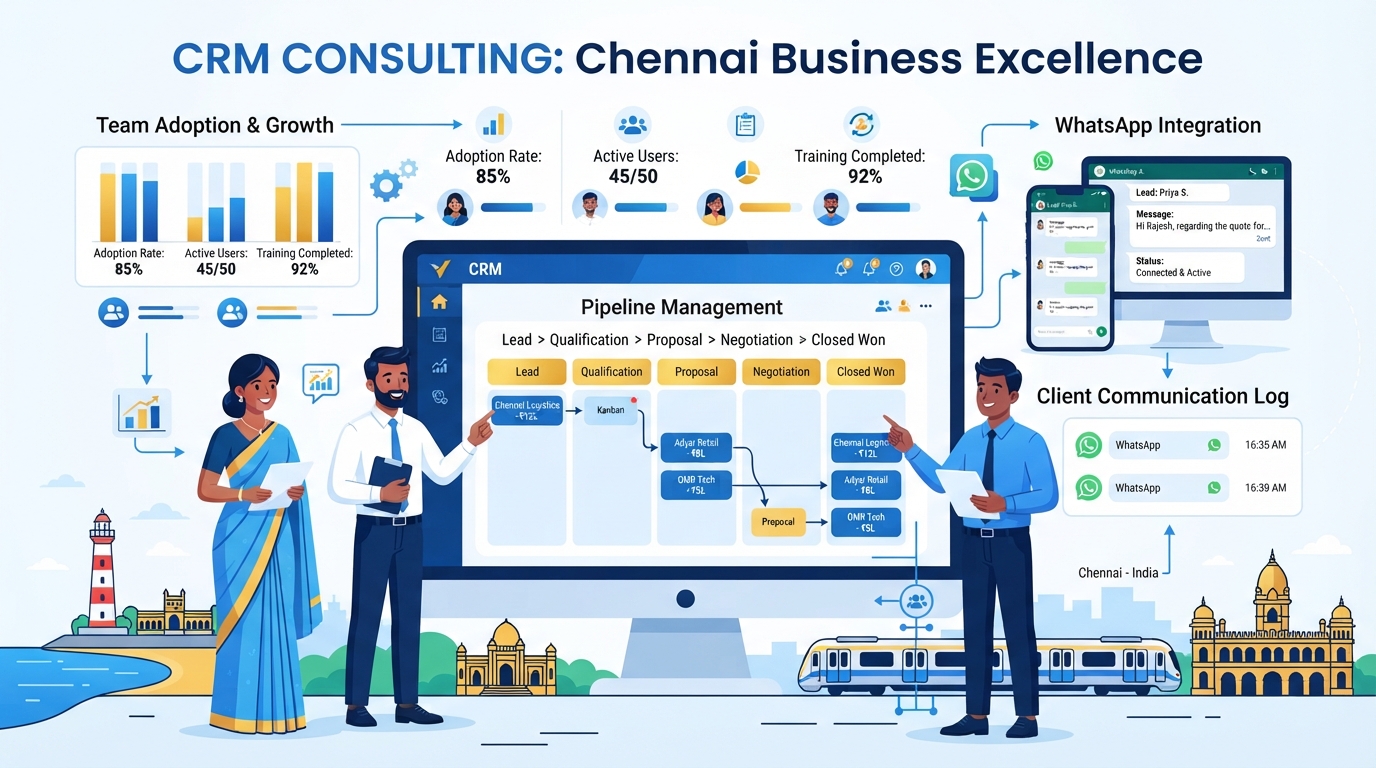
CRM consulting in Chennai is one of the most undervalued investments a growing business can make — and also one of the most misunderstood. Every year, hundreds of businesses across Chennai and Tamil Nadu purchase a CRM system with the expectation that it will organise their sales pipeline, improve follow-up, and help them grow. And every year, most of those CRMs end up largely unused — another subscription running in the background while the sales team continues to manage leads on WhatsApp and spreadsheets. The problem is almost never the software. It is how the CRM is selected, implemented, and adopted. This guide explains exactly why most CRM projects fail, what Chennai businesses need to do differently, and how professional CRM consulting transforms a purchased tool into a functioning revenue system.
What Is CRM Consulting?
CRM consulting is the professional practice of helping a business select the right CRM system, configure it correctly for their specific processes, integrate it with their existing tools and lead sources, train their team to use it effectively, and build automation workflows that make the system work without constant manual effort.
A CRM consultant is not a software salesperson. Their job is to understand your business processes — how leads arrive, how they are tracked, how follow-ups happen, how deals are logged — and then design a CRM setup that reflects and improves that reality, not replaces it with something unrecognisable to your team.
For a Chennai business, CRM consulting typically includes:
- Identifying the right CRM for your business type, budget, and team size
- Mapping your current sales and follow-up process onto the CRM
- Connecting lead sources — Facebook Ads, Google Ads, WhatsApp, website forms
- Setting up automation for lead assignment, follow-up reminders, and pipeline movement
- Training your sales team to use the system daily without resistance
- Building dashboards and reports so you can see your business at a glance
- Ongoing optimisation as your business grows and processes evolve
The Uncomfortable Truth About CRM in India: Most Don't Work
Before discussing what good CRM consulting looks like, it is important to understand why so many CRM projects fail — because the pattern is consistent and predictable.
Research published in 2025 found that 55% of CRM implementations fail to achieve their planned objectives. That is not a bug in the system — it is a feature of how most organisations approach CRM.
Other research puts the figure even higher. Despite decades of technological advancement and multi-billion-dollar investments, studies indicate that 60–70% of CRM implementations fail to meet their intended objectives.
For Chennai SMEs, the failure rate is likely higher — not because businesses here are less capable, but because most CRM implementations happen without proper consulting support. A business owner purchases a CRM based on a recommendation or an online search, spends a weekend trying to configure it, and then hands it to their sales team with minimal training. Within three months, the team has reverted to WhatsApp and spreadsheets.
Why CRM Implementations Fail: The Real Reasons
The popular assumption is that CRM projects fail because of the software. The data says something completely different.
People and process issues account for over 75% of CRM failures, while technical problems with the software itself account for less than 10%.
The biggest reasons CRM projects fail are: poor user adoption (47% of failures), lack of executive buy-in (33%), inadequate training and change management, trying to automate broken processes, and no clear definition of success metrics before implementation begins.
Let us break these down in the context of a Chennai business:
Reason 1: The Team Was Not Involved in the Decision
The business owner researches and purchases the CRM. The sales team learns about it on implementation day. They were not consulted about their workflow, their daily challenges, or what would make their job easier. The result is a system built around assumptions — not around how the team actually works.
Reason 2: The Process Was Not Defined Before Automation
A CRM can only automate a process that exists. If your lead follow-up process is "whoever has time calls back when they can," the CRM will faithfully automate that chaos. You must define the ideal process — who does what, in what order, within what timeframe — before the CRM is configured to reflect it.
Reason 3: Training Was a One-Time Event
65% of CRM users say training is essential for success. Companies with ongoing training programs show 34% higher sales productivity. A single training session on implementation day is not training. It is a demonstration. Real adoption requires ongoing support, feedback, and reinforcement — especially in the first 90 days.
Reason 4: The CRM Was Too Complex for Daily Use
58% of users feel overwhelmed by feature complexity. Most CRMs are feature-rich platforms designed to impress in a demo. In daily use, that complexity becomes friction. A well-configured CRM for a Chennai SME should be simple enough that the average salesperson can log a lead, update a status, and check their follow-up tasks in under two minutes.
Reason 5: Nobody Was Accountable for CRM Performance
The apex killer of CRM implementations is low user adoption, which is independently responsible for nearly 40% of all project failures. Across all industries, average CRM adoption rates remain at just 26%. This means three in four people with CRM access are not using it in a way that produces useful data for the business.
Without clear accountability — someone whose job it is to monitor usage, enforce discipline, and improve the setup — the CRM gradually becomes irrelevant.
What Good CRM Consulting Looks Like for a Chennai Business
Good CRM consulting is not about recommending the most expensive software. It is about designing a system that your team will actually use — and that produces measurable business outcomes.
Here is what the process should look like:
Phase 1: Business Process Audit (Week 1)
Before any software is discussed, a good CRM consultant maps your current reality:
- How do leads currently arrive? (Phone calls, WhatsApp, Google forms, Facebook ads)
- What happens to a lead in the first hour? First day? First week?
- How does your team currently track their follow-up tasks?
- What is your current conversion rate from lead to customer?
- What data do you need to see to manage your business effectively?
This audit reveals the gaps — the points in your process where leads are falling through — and forms the foundation of the CRM configuration.
Phase 2: CRM Selection (Week 1–2)
The right CRM is not always the most well-known one. For most Chennai SMEs, the selection criteria should include:
| Criteria | What to Look For |
|---|---|
| Ease of use | Can your team use it without daily IT support? |
| WhatsApp integration | Critical for Chennai's business communication culture |
| Lead source integration | Connects directly to Facebook, Google, website forms |
| Automation capability | Follow-up sequences, reminders, pipeline movement |
| Mobile accessibility | Salespeople are often on the move |
| Local support | Can you get help in your time zone quickly? |
| Pricing | Predictable, scalable, no surprise costs |
Phase 3: CRM Configuration (Week 2–3)
This is where the CRM is built to reflect your actual business:
- Pipeline stages are mapped to your actual sales journey
- Lead sources are connected so every enquiry flows in automatically
- Automation workflows are configured for instant lead response and follow-up
- Custom fields are created for information relevant to your business
- User roles and permissions are set up by team function
- Dashboards are built for the reports you actually need
Phase 4: Team Training and Adoption (Week 3–4)
Companies that invest in change management are 3.5 times more likely to succeed with their CRM implementation than those that treat it as a technology project.
Training for a Chennai business needs to be practical, not theoretical. Your sales team should leave training knowing exactly how to:
- Log a new lead and assign it correctly
- Update a lead status after a call or WhatsApp conversation
- Add notes and set follow-up reminders
- Interpret their personal dashboard
- Use the mobile app when they are out of the office
Phase 5: 90-Day Optimisation
The real work of CRM consulting begins after go-live. In the first 90 days, a consultant should monitor adoption rates, identify where team members are skipping steps, refine automation sequences based on actual lead behaviour, and adjust the configuration as the business provides feedback.
When businesses deploy solutions that capture previously missed opportunities, they see an average 27% increase in booked appointments within the first 90 days — and this increase comes entirely from opportunities that were previously going unanswered, without any additional marketing spend.
CRM Without Consulting vs. CRM With Consulting: A Reality Check
| Scenario | Without CRM Consulting | With CRM Consulting |
|---|---|---|
| Setup time | Weeks of trial and error | Structured, focused implementation |
| Team adoption | 20–30% use it regularly | 70–85% active usage |
| Data quality | Incomplete, unreliable | Clean, consistent, actionable |
| Automation working | Rarely configured correctly | Configured to your process from day one |
| Time to ROI | 6–18 months, if ever | 60–90 days |
| Common outcome | CRM abandoned within 6 months | Pipeline visible, follow-up consistent |
7 Signs Your Chennai Business Needs CRM Consulting Right Now
- Your team uses WhatsApp to track leads — conversations are the pipeline and nothing is ever formally logged
- You do not know your current lead-to-customer conversion rate — no data, no baseline
- You have purchased a CRM but less than half your team uses it — adoption failure in progress
- Leads fall through the cracks regularly — enquiries arrive but follow-up is forgotten
- You cannot tell which ad campaign is generating your best leads — no source attribution
- Your sales team's pipeline reports are done on spreadsheets — the CRM is not functioning as intended
- You have no visibility into how long deals take to close — pipeline velocity is unmeasured
If three or more of these describe your business, CRM consulting is not a nice-to-have — it is the fastest route to a functioning revenue system.
FAQ: CRM Consulting in Chennai
Q: Do I need CRM consulting or can I set it up myself?
Most business owners can set up a basic CRM. But "set up" and "configured to drive revenue" are very different things. Self-configured CRMs typically have low adoption, poor automation, and no integration with lead sources. CRM consulting closes that gap and ensures your investment actually pays off.
Q: How long does CRM consulting take for a Chennai SME?
A well-run CRM implementation for a small to medium Chennai business typically takes three to four weeks from audit to go-live, followed by a 90-day optimisation period. The 90-day period is often where the real results are built.
Q: Which CRM is best for a Chennai business?
There is no single right answer — it depends on your team size, the nature of your sales process, your lead sources, and your budget. A CRM consultant's job is to match the right platform to your specific situation rather than recommend the same tool to everyone.
Q: What is the ROI of CRM consulting?
The ROI comes from two sources: revenue recovered through better follow-up and lead management, and time saved by eliminating manual, repetitive tasks. Most Chennai businesses that invest in proper CRM consulting see a measurable improvement in conversion rate within 60–90 days.
Q: Can a CRM integrate with WhatsApp for a Chennai business?
Yes. Modern CRM platforms — including the one used by RevMax AI — support full WhatsApp Business API integration, meaning every WhatsApp conversation is logged, trackable, and triggerable by automation workflows.
Q: What happens if my team refuses to use the CRM after it is set up?
Resistance is normal and expected. CRM adoption is fundamentally about people, not technology. You are asking humans to change behaviour, which is hard even when the change is beneficial. The strategy that works is one that makes the new behaviour genuinely easier and more valuable than the old behaviour — and then supports people through the transition with patience, training, and tools that actually solve their problems. A CRM consultant helps manage this transition actively, not just at go-live.
Is your CRM sitting unused while your team manages leads on WhatsApp? Book a free CRM audit with Revenue Mastery Consulting at our Anna Salai office — No. 781, Rayala Towers, Chennai 600002.
Read More From Revenue Mastery Consulting
- AI Sales Automation in Chennai: Close More Deals Without Increasing Your Sales Team
- Business Automation in Chennai: How AI Is Replacing Manual Follow-Ups
- Best CRM for Tamil Nadu Small Businesses in 2026
- Why Tamil Nadu Business Owners Lose 79% of Their Leads (And How to Stop It)
Related Articles
How to Rank Your Chennai Business on Google Maps in 60 Days (Local SEO Guide 2026)
Want your Chennai business in Google Maps top 3? This step-by-step local SEO guide covers everything Tamil Nadu business owners need.
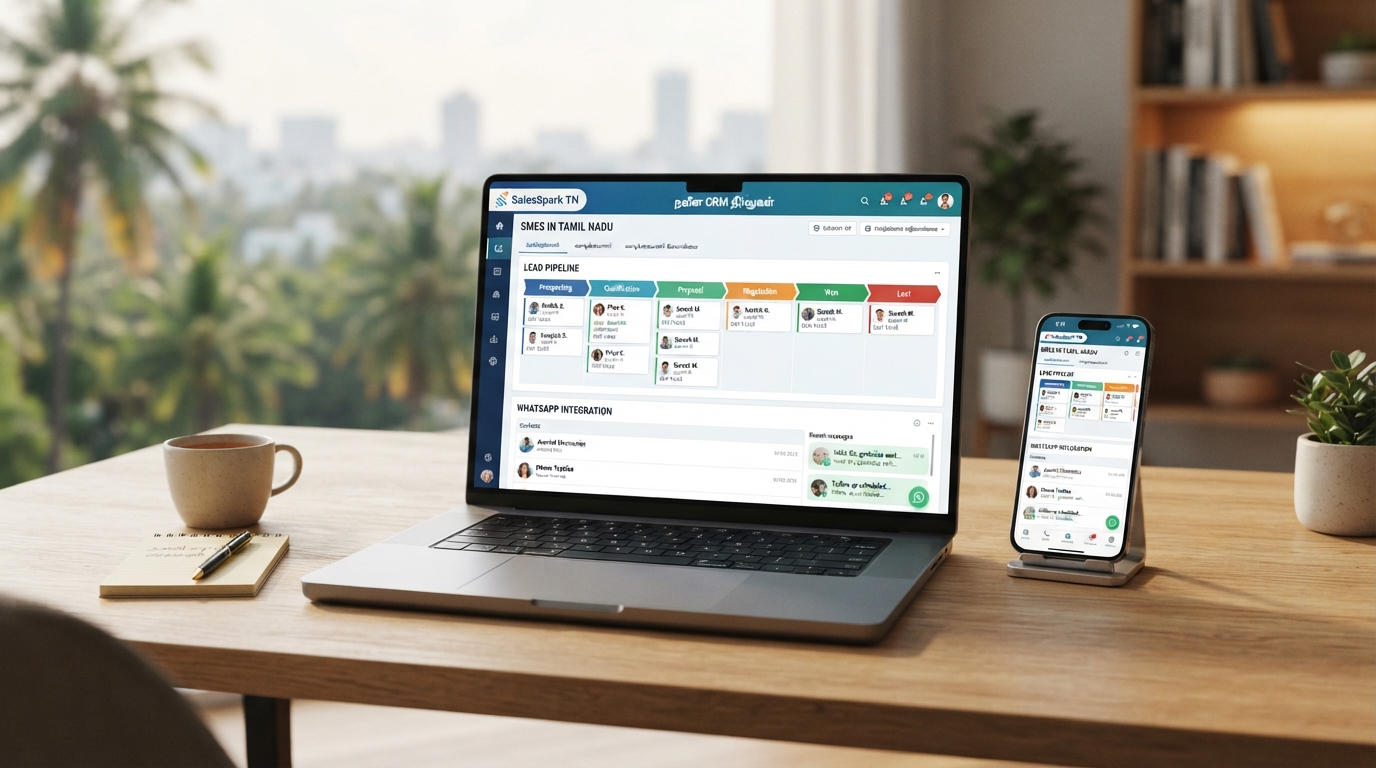
Best CRM for Tamil Nadu Small Businesses in 2026: Honest Buyer's Guide
Looking for the best CRM for your Tamil Nadu small business in 2026? This guide explains what to look for, what to avoid, and which features actually generate revenue in the Indian market.

AI Digital Marketing for E-Commerce Businesses in Chennai: How to Sell More With Less Ad Spend
Running an online store in Chennai? Discover how an AI digital marketing agency reduces your cost per sale, recovers abandoned carts automatically, and scales revenue.